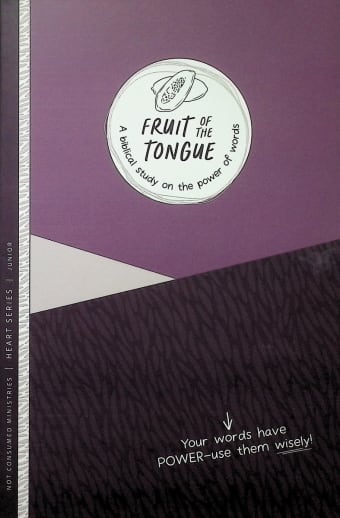
Fruit of the Tongue Bible Study - Junior (Heart Series)
SKU
053430
Grade 3-7
These icons are designed to help you quickly understand and learn important information about our products.
Teaching Method
Traditional
Teacher-centered curriculum commonly used in classrooms that may include a text, teacher manual, tests, etc.
Charlotte Mason
A methodology based on the work of a 19th century educator who maintained that children learn best from literature (Living Books), not textbooks.
Classical
A methodology based on the Latin Trivium (three stages of learning), including the grammar stage (memorization and facts), logic stage (critical thinking), and rhetoric stage (developing/defending ideas).
Unit Study
A thematic or topical approach centered around one topic that integrates multiple subject areas.
Montessori (Discovery)
A methodology based on the work of a 20th century educator that emphasizes student and sensory-driven discovery learning and real-life applications.
Other
Other methodologies
Religious Content
Secular
Contains content contrary to common Christian beliefs (i.e. evolution).
Neutral
Avoids religious or theoretical topics or presents multiple viewpoints without preference.
Christian/Religious
Faith-based or including instructional religious content.
Learning Modality
Auditory
Learns through listening, talking out loud or reading out loud.
Visual
Learns through seeing, prefers written instructions and visual materials.
Kinesthetic/Tactile (Hands-On)
Learns through moving, doing and touching.
Multi-Sensory
Curriculum that employ a variety of activities/components.
Presentation
Sequential
Curriculum progresses through well-defined learning objectives. Emphasizes mastery before moving to the next topic.
Spiral
Topics and concepts are repeated from level to level, adding more depth at each pass and connecting with review.
Conceptual/Topical
Focus is on the “why,” often with a unifying concept as well as specific skills; coverage may be broader.
Teacher Involvement
Low Teacher Involvement
Student-led materials; parent acts as a facilitator.
Medium Teacher Involvement
A mix of teacher-led time and independent student work.
High Teacher Involvement
Teacher-led lessons; may utilize discussions, hands-on activities and working together.
Additional Materials Required
No other materials needed
Everything you need is included.
Other Materials Required
There are additional required resources that are a separate purchase.
Other Materials Optional
There are additional resources mentioned or recommended but are not absolutely necessary.
Using our words for good instead for evil is hard battle to
fight; equip upper elementary students with the Fruit of the Tongue Bible
Study-Junior Levelfrom Not Consumed Ministries. This study
encourages students to use their words wisely and speak of things that are
good, beautiful, and true. Students work more independently as they discover the
provision in God’s Word. Students are provided with lines, blank spaces, and
designated areas to record their thoughts and reflections. The Key Verse and
Key Truth are the same throughout all levels, providing a connecting point for
discussion. This program encourages students to spend intentional time in their
Bibles, discovering and reflecting on God’s Word before coming back together as
a family to discuss and refine their reflection. The included extras are a
Bookmark highlighting what our words should do; a sheet of 19 study-specific
stickers to decorate your booklet, Bible, or personal journal; and 4 Junior
Challenge cards that are tasks catered specifically to upper elementary
children. 45 pgs., paperback. ~Rebecca
Publisher's Description of Fruit of the Tongue Bible Study - Junior (Heart Series)
Is your family struggling with hurtful or unkind words?
Kids need more than reminders—they need to understand how their words affect others.
Fruit of the Tongue is a 20-lesson Bible study that takes kids into God’s Word to see what Scripture says about the power of their words. Each lesson takes just 10–15 minutes and requires no prep.
The volume of our words is not the only thing we should be
teaching and monitoring regarding our children’s speech. Through the Fruit
of the Tongue Bible Study from Not Consumed Ministries, every member of
your family learns that words have power. A biblical approach to understanding
the impact, both good and bad, that words have on others and oneself. Learning
to tame our tongue is a lifelong lesson God is teaching us with every
opportunity. There is a study book appropriate for every member of your family,
from the primary level (ages 5-7) to junior (ages 8-12) to youth (ages 13+), to
the parents’ guide. Scripture references are provided at every level,
encouraging everyone to open their Bibles and study the Word of God. There are
20 days of study, and these can be completed in a way that best suits your
family: once a day or once a week.
~Rebecca