
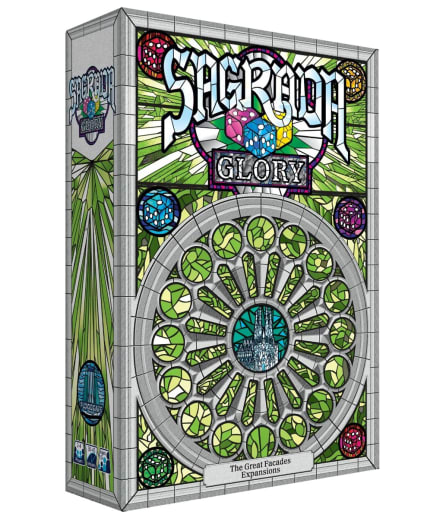
This is the third of three expansions in the "Great Facades" series published in 2022 with the theme of bringing glory to the art of stained glass through enhanced competition. Included are the following modules and components.
Strife Module with 18 gray Strife dice, 6 Strife Dice Boards, 3 Strife Tool Cards and 6 Strife Public Objective cards—This is the largest module in the expansion, the core of which is the gray Strife Dice. When using this module, game setup changes in that a specific number of dice per color are placed in the drafting bag along with strife dice determined by player count. The remaining strife dice are put into a pool. One Strife Dice Board is randomly chosen. This board provides specific conditions that strife dice must follow when placed on a player’s window. There will be at least one Strife Die in the draft pool each round because only 2 times the player count number of dice are drafted from the bag with one additional die being drafted from the private draft pool each turn.
The Strife Dice can sit next to any color, as they are neutral colored, but must adhere to regular placement rules for value and they cannot be placed next to other Strife Dice, as they are the same color. One Strife Tool card is drafted that specifically enhances grey dice. One Strife public objective card is used that ties in with placement of strife dice. Two core game tool cards and public objective cards are used along with private goals from the core game. I found this module to be easy to adapt to the core game and to provide additional challenge and scoring opportunities for variety.
Pioneer Module with 15 Pioneer Objective Cards—This Module uses three cards from this deck in addition to the public and private goals. These are challenge cards that are claimed by the first person to meet them, and points are awarded at game end. Examples are: Be the first person to 1) have a column of dice of different colors and values, or 2) Complete the entire outside frame of your windows. Adding these cards provides additional strategy and timing incentives. I liked playing it with just the base Sagrada game without complicating the game too much. This works well for newcomers to the game who just want a bit of extra variety. Of course, the module can also be used with any other modules for this game.
Flourish Module with 12 private objectives—Each player receives two of these cards and may choose to keep none or one in addition to a private objective from the core Sagrada game. For each card kept, they also receive one additional favor token. The Flourish cards all show a color pattern that must be completed to earn the points indicated. The caveat here is that for each card kept but not completed, the player loses the number of points indicated on the card, which can be between 4 to 8 points! This small module packs a big punch with risk/reward and the wrong decision could determine whether a player wins or loses!
Rivalry Module with 6 public objective cards—Although there are six of these cards, there are also three from the Strife Module that can be used with the Rivalry Module. All these cards provide comparative point values based on having the most vs. 2nd or 3rd place among players of a specific dice arrangement. They can be mixed in with other public goals to help randomize game play.
In summary, the Glory Module provides a variety of opportunities to supplement gameplay with cards and modules from both the base game and other expansions. It is fun to experiment with different combinations between them! For 2-4 players with the base game of Sagrada required and a 30–45-minute play time. - Marsha