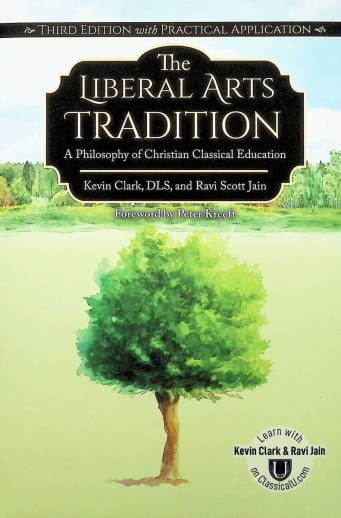

The 3rd edition of this book not only expands, deepens, and continues the elegant discussion by Kevin Clark and Ravi Scott Jain on the elements of a traditional liberal arts education, but also offers practical steps to get there in today’s world! Showing the relationship between the tools of learning (trivium and quadrivium), theology, piety, gymnastic and music, and philosophy, and coming from a biblical and Christian viewpoint, the authors note that "the foundational distinction between traditional education and modern education is that the ancients believed that education was fundamentally about shaping loves." The new appendix section is especially helpful, including a treasure trove of resources for successful implementation, such as book lists, checklists, summaries, and more! 380 pgs. hc.
Liberal Arts Tradition: Philosophy of Christian Classical Education (3rd Edition)
Description
Since the publication of the first edition of The Liberal Arts Tradition in 2014, this book has been read and circulated by thoughtful educators around the world who are interested in what great education once was and might be again. Assigned in college classes, read by school faculties, and studied in homeschooling communities, it has been widely reviewed and recommended by many scholars, bloggers, and experts. The authors thoroughly revised the text in 2019, expanding and deepening their presentation of the core elements of the liberal arts tradition, which include piety, music, gymnastic, liberal arts, philosophy, and theology. In this latest release, they have taken a step further, suggesting practical ways to begin implementing the educational philosophy discussed. This is a must-read for educators desiring practical ways to further the recovery of classical education.
The Liberal Arts Tradition: A Philosophy of Christian Classical Education introduces readers to a paradigm for understanding a classical education that transcends the familiar 3-stage pattern of grammar, logic, and rhetoric. Instead, this book describes the liberal arts as a central part of a larger and more robust paradigm of classical education that should consist of piety, gymnastic, music, liberal arts, philosophy, and theology. The Liberal Arts Tradition also recovers the means by which classical educators developed more than just intellectual virtue (by means of the 7 liberal arts) but holistically cultivated the mind, body, will, and affections. This is a must-read for educators who want to take a second big step toward recovering the tradition of classical education.
Now in hardcover, the revised edition of The Liberal Arts Tradition has been expanded and updated throughout to reflect the most recent understandings and philosophies of classical education. It also includes 40 percent new content, featuring:
- Expanded Trivium pieces
- Expanded "Moral Philosophy" piece, with more nuanced discussions of virtue and the role of the Church
- Completely new "Calling, Culture, and Curriculum" section addressing (1) biblical foundations for classical Christian education, (2) the relationship of classical Christian education to the Church and other cultures, and (3) the relationship between the liberal, common, and fine arts
- Revised "Natural Philosophy" piece
- Updated paradigm of the liberal arts tradition
- Glossary
- New appendices, including one on reading and one entitled "A New Natural Philosophy"
What's new in the third edition with practical application? In this latest release, authors Dr. Kevin Clark and Ravi Jain join with David Goodwin (Director, Association of Classical Christian Schools) to explore and discuss practical ways to implement the educational philosophy discussed in The Liberal Arts Tradition. This update includes practical guides and checklists, insightful essays, and other resources that will aid educators in directing students in the pursuit of the true, the good, and the beautiful!
| Product Format: | Hardcover |
|---|---|
| Grade: | AD |
| Brand: | Classical Academic Press |
| ISBN: | 9781600514470 |
| Length in Inches: | 9.375 |
| Width in Inches: | 6.25 |
| Height in Inches: | 1.1875 |
| Weight in Pounds: | 1.85 |