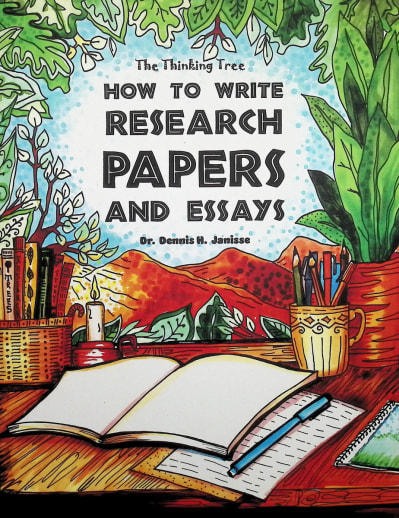
Writing is a skill, and to grow, it must be practiced. This is a step-by-step guide to writing from the ground up. Students will start by writing about things that interest them, followed by things that they want to know more about. The five-paragraph essay construction is taught, followed by the steps to writing a research paper, from the ideas to outline to first draft to edit and finally, the final draft. The Dyslexia font by Christian Boer helps students read and process easier and isn’t as overwhelming. The journal includes all the prompts, diagrams, and space needed to write seven essays and seven research papers. Instructions for constructing footnotes are found in the appendix. 253 pgs, pb. ~Amber
How to Write Research Papers and Essays (Step by Step Guide)
SKU
048747
Grade 7-12
These icons are designed to help you quickly understand and learn important information about our products.
Teaching Method
Traditional
Teacher-centered curriculum commonly used in classrooms that may include a text, teacher manual, tests, etc.
Charlotte Mason
A methodology based on the work of a 19th century educator who maintained that children learn best from literature (Living Books), not textbooks.
Classical
A methodology based on the Latin Trivium (three stages of learning), including the grammar stage (memorization and facts), logic stage (critical thinking), and rhetoric stage (developing/defending ideas).
Unit Study
A thematic or topical approach centered around one topic that integrates multiple subject areas.
Montessori (Discovery)
A methodology based on the work of a 20th century educator that emphasizes student and sensory-driven discovery learning and real-life applications.
Other
Other methodologies
Religious Content
Secular
Contains content contrary to common Christian beliefs (i.e. evolution).
Neutral
Avoids religious or theoretical topics or presents multiple viewpoints without preference.
Christian/Religious
Faith-based or including instructional religious content.
Learning Modality
Auditory
Learns through listening, talking out loud or reading out loud.
Visual
Learns through seeing, prefers written instructions and visual materials.
Kinesthetic/Tactile (Hands-On)
Learns through moving, doing and touching.
Multi-Sensory
Curriculum that employ a variety of activities/components.
Presentation
Sequential
Curriculum progresses through well-defined learning objectives. Emphasizes mastery before moving to the next topic.
Spiral
Topics and concepts are repeated from level to level, adding more depth at each pass and connecting with review.
Conceptual/Topical
Focus is on the “why,” often with a unifying concept as well as specific skills; coverage may be broader.
Teacher Involvement
Low Teacher Involvement
Student-led materials; parent acts as a facilitator.
Medium Teacher Involvement
A mix of teacher-led time and independent student work.
High Teacher Involvement
Teacher-led lessons; may utilize discussions, hands-on activities and working together.
Additional Materials Required
No other materials needed
Everything you need is included.
Other Materials Required
There are additional required resources that are a separate purchase.
Other Materials Optional
There are additional resources mentioned or recommended but are not absolutely necessary.
Consumable
Consumable
Designed to be written in; not reusable.
Non-Consumable
Not designed to be written in; reusable.
Our Price
$27.50 $27.50 $24.50
Rainbow Savings: $3.00
Product Overview
- Step-by-step writing process for essays and research papers
- Resource for reluctant writers needing clear guidance
- Thinking Tree uses Dyslexia font by Christian Boer, which is easier to read
- Reproducible for family use
Description
Publisher's Description of How to Write Research Papers and Essays (Step by Step Guide)
A gentle, user-friendly approach to writing including 15 writing projects of various types, culminating in research-based writing.
Students begin slowly and simply, writing about topics that interest them just to get the juices flowing and to build confidence.
Guidance is provided all along the way as students learn how to ask good questions, and examine what approaches can be used to write about their topics.
Specifics are given on principles like: using a key words and Venn diagrams how to organize sources and ideas how to outline (templates provided) brainstorming and planning (planning forms included) the construction of a good paragraph the structure of a well-written paper how to formulate good footnotes.
The journal methodically maps out the writing of drafts and revisions. Helpful tips from the author are scattered throughout the lessons. There is a gradual easing-into writing on appointed topics that are informative, biographical, comparison/contrast, or persuasive in nature.
Young writers are guided in how to practically apply all the structural knowledge they've gleaned in the beginning sections of the book. This thick journal provides ample space for each assignment to be written within its covers, so that the finished product will be a very nice portfolio of the student's growth in the writing process.
Students begin slowly and simply, writing about topics that interest them just to get the juices flowing and to build confidence.
Guidance is provided all along the way as students learn how to ask good questions, and examine what approaches can be used to write about their topics.
Specifics are given on principles like: using a key words and Venn diagrams how to organize sources and ideas how to outline (templates provided) brainstorming and planning (planning forms included) the construction of a good paragraph the structure of a well-written paper how to formulate good footnotes.
The journal methodically maps out the writing of drafts and revisions. Helpful tips from the author are scattered throughout the lessons. There is a gradual easing-into writing on appointed topics that are informative, biographical, comparison/contrast, or persuasive in nature.
Young writers are guided in how to practically apply all the structural knowledge they've gleaned in the beginning sections of the book. This thick journal provides ample space for each assignment to be written within its covers, so that the finished product will be a very nice portfolio of the student's growth in the writing process.
Category Description for Expository Writing
These materials cover various types of informational writing, includingpersuasive writing, essays, outlines, and research papers.
Details
| Product Format: | Paperback |
|---|---|
| Grades: | 7-12 |
| Brand: | The Thinking Tree |
| EAN/UPC: | M0D2053478720 |
| Length in Inches: | 11 |
| Width in Inches: | 8.5 |
| Height in Inches: | 0.625 |
| Weight in Pounds: | 1.35 |
Videos
Reviews