
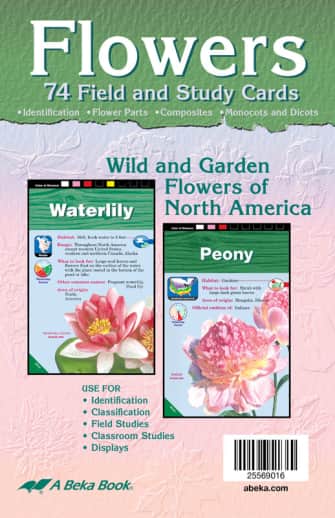
These 74 dual-sided cards provide a plethora of information for North American flowers. Card A explains flower parts; Card B explains composite flowers. Then, the top of each card identifies the blossom colors available. The cards display the flower in bloom and then the Latin name; actual size indications; and whether the flower is dicot, monocot, or composite. Quickly identifiable graphics indicate the growth; habitat; flower zones; flowering period; habitat and range; identification tips; and area of origin. Learn unique things about flowers, such as the fact that pitcher plants trap insects and “eat” them; that the Mountain Avens plant is the official emblem of the Canadian Northwest Territories; and which flowers are poisonous. The back of each card includes a full-size drawing of full blooms and blossoms. Rather than photographs, these are hand drawn and colored, and include a flashcard number for easy reference with Abeka® programs. Also included are diagram explanations of monocots and dicots; a handy field guide of common flower families; field guide; and habitats.
Abeka Flowers Field and Study Cards
Description
You and your child will marvel at these beautiful illustrations of common wildflowers and garden flowers of North America that we all should be able to identify. They are the kind of learning tools for teaching and reviewing that you want to look at over and over! The set includes 74 (5½" x 8½") full-color cards.
The 4 concept cards identify the parts of a flower and monocots, dicots, and composites. The flower parts card identifies each part and its function on one side of the card; the other side is unlabeled for review. The monocots, dicots, and composites cards list the characteristics and representative flowers (including the flower flashcard number) on one side of the card. The opposite side illustrates the characteristics. Teach your child God’s marvelous design for flowers!
The 70 identification cards feature a full-color picture of the flower on one side of the card. The opposite side gives the flower’s name, an illustration that includes the scientific name, and helpful information for identifying the flower along with interesting facts. Open your child’s eyes to the natural beauty that surrounds us.
The accompanying 16-page booklet includes teaching instructions and helpful listings, such as categorizing the flowers by flower families or by their flowering seasons. You can quickly grab just the cards you need for flowers that may be blooming when you go on a field study.
Use the cards to improve your child’s observation skills and give him a deeper appreciation of God’s care and design in His creation. Display these colorful cards on bulletin boards or in the science corner or take them along outdoors for field studies. Gr. 4–7.
Investigating God’s World Fifth Edition from Abeka has some exciting new updates. The topics are more diverse and cover several new areas of study. Earth science takes students from the study of the solar system to the earth itself with geology, weather, and more. Life science includes topics of marine biology and ecology. Physical science, with a look at chemistry, energy, force, and motion, introduces students to the ingenuity God instilled in His creation. Softcover, the Student Textbook provides the readings, hands-on activity suggestions, comprehension checks, and chapter check-up questions. Space to record answers is included in the book. Answers to these questions are found in the Investigating God’s World Answer Key.
New to this edition is the Investigating God’s World STEM Activities Workbook, which correlates with the textbook. Built-in lab days provide hands-on learning and inspire love for studying our planet. Answers for each activity are included in the STEM Activities Key.
Additional resources include the Quiz and Test book that contains 21 quizzes and 9 tests, including 2 nine-week examinations and 1 semester examination. Answers are found in the Quiz and Test Answer Key. The Quiz and Test book and the STEM Activities workbook are not reproducible, so each student will need their own book.
Suggested resources include the Science 5 Homeschool Teaching Charts, which enhance lessons and help introduce and reinforce material, and Science 5 Flashcards, which expand on the scientific concepts presented in the charts.
Investigating God’s World and Enjoying Good Health together make up the fifth grade Abeka science program. The Homeschool Science 5 Curriculum Lesson Plans contain daily lessons for science class for lessons 1–130. The Homeschool Health 5 Curriculum Lesson Plans contain daily lessons for health lessons 131–170. All lesson plans include a scope and sequence for the entire course, materials needed, an outline for each lesson, STEM activity pacing, and suggestions for introducing and reviewing information. Each lesson will take about 30 minutes to complete. While these two programs were designed to work together, they could each be done independently as well. Science and Health items are sold individually and are also available in respective Parent and Child kits. Both are recommended for successful teaching.
Enjoying Good Health fourth edition presents a balanced approach to a range of topics, including nutrition, body systems such as the digestive system and the lymphatic system, and mental, social, and spiritual habits, equipping students to take personal responsibility for their overall health. Softcover, the Student Textbook provides the readings, hands-on activity suggestions, comprehension checks, and chapter check-up questions. Space to record answers is included in the book. Answers to these questions are found in the Enjoying Good Health Answer Key.
Also new to this edition is the Enjoying Good Health Activity Book, which provides review and hands-on application of the material presented in the student text through various activities such as data collection, charting meals to encourage a healthy lifestyle, model construction, classroom experiments, and lab activities. Answers are included in the Enjoying Good Health Answer Key.
Additional resources include the Quiz and Test book that contains 7 quizzes and 3 tests, including 1 exam. Answers are found in the Quiz and Test Answer Key. The Quiz and Test book and the Activities workbook are not reproducible, so each student will need their own book.
Suggested resources include the Health 5 Homeschool Teaching Charts. ~Amber
| Product Format: | Other |
|---|---|
| Grade: | 4 |
| Brand: | Abeka |
| ISBN: | 9780000025562 |
| Length in Inches: | 8.5 |
| Width in Inches: | 5.5 |
| Height in Inches: | 1 |
| Weight in Pounds: | 1.5 |