
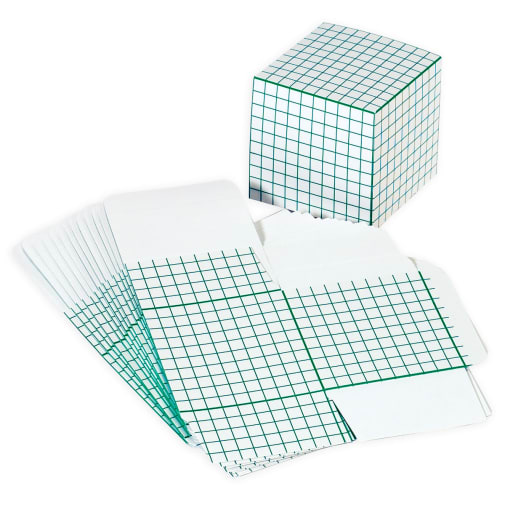
Die-cut flats which fold easily into a perfect 10cm x 10cm sturdy cardstock cube.
Set of 16 thousands cubes (flat) die-cut
SKU
045782
Grade PK-3
These icons are designed to help you quickly understand and learn important information about our products.
Teaching Method
Traditional
Teacher-centered curriculum commonly used in classrooms that may include a text, teacher manual, tests, etc.
Charlotte Mason
A methodology based on the work of a 19th century educator who maintained that children learn best from literature (Living Books), not textbooks.
Classical
A methodology based on the Latin Trivium (three stages of learning), including the grammar stage (memorization and facts), logic stage (critical thinking), and rhetoric stage (developing/defending ideas).
Unit Study
A thematic or topical approach centered around one topic that integrates multiple subject areas.
Montessori (Discovery)
A methodology based on the work of a 20th century educator that emphasizes student and sensory-driven discovery learning and real-life applications.
Other
Other methodologies
Religious Content
Secular
Contains content contrary to common Christian beliefs (i.e. evolution).
Neutral
Avoids religious or theoretical topics or presents multiple viewpoints without preference.
Christian/Religious
Faith-based or including instructional religious content.
Learning Modality
Auditory
Learns through listening, talking out loud or reading out loud.
Visual
Learns through seeing, prefers written instructions and visual materials.
Kinesthetic/Tactile (Hands-On)
Learns through moving, doing and touching.
Multi-Sensory
Curriculum that employ a variety of activities/components.
Presentation
Sequential
Curriculum progresses through well-defined learning objectives. Emphasizes mastery before moving to the next topic.
Spiral
Topics and concepts are repeated from level to level, adding more depth at each pass and connecting with review.
Conceptual/Topical
Focus is on the “why,” often with a unifying concept as well as specific skills; coverage may be broader.
Teacher Involvement
Low Teacher Involvement
Student-led materials; parent acts as a facilitator.
Medium Teacher Involvement
A mix of teacher-led time and independent student work.
High Teacher Involvement
Teacher-led lessons; may utilize discussions, hands-on activities and working together.
Additional Materials Required
No other materials needed
Everything you need is included.
Other Materials Required
There are additional required resources that are a separate purchase.
Other Materials Optional
There are additional resources mentioned or recommended but are not absolutely necessary.
Consumable
Consumable
Designed to be written in; not reusable.
Non-Consumable
Not designed to be written in; reusable.
Our Price
$29.95 $29.95 $21.95
Rainbow Savings: $8.00
Description
Publisher's Description of Set of 16 thousands cubes (flat) die-cut
These decimeter die-cut flats cubes easily (and without glue) go from flat into perfect 10cm x 10cm x 10cm 3D thousand cubes in a jiffy! With a cost 70% less than the plastic thousand cubes, these 1000-cube flats are an excellent savings opportunity - making visual, tactile, and kinesthetic homeschool math more economical than ever. Package of 16 to be assembled into 3D thousand cubes. Included in Math Kit I and a perfect addition to any base ten set.
Category Description for ShillerMath
Bring home the benefits of Montessori math! ShillerMath helps parents guide their children in becoming math “fluent”. Instruction is student-paced, incrementally spiral, and guarantees plenty of practice. Teaching follows a 3-period lesson (developed by Maria Montessori): “This is,” “Show me,” and “What is.” This process ensures the child understands each concept. Parent Lesson Books are scripted and easy to implement. Lessons build spirally. Daily lessons take about 15 minutes for a 3- or 4-year-old. Add about 5 minutes daily for each year beyond age 4. Other factors can also drive lesson length. If, for example, a student has grasped and applied the day’s concept/skill and is ready to move on, then so be it. Daily lessons going long? Divide into smaller portions. Kits come with instructions to obtain free access to unlimited printable PDFs. Each Level Kit is a complete math program that can be used for up to 5 years. Kit I covers skills for ages 4-8. Kit II teaches skills for ages 9-13. After Kit II, students should be prepped for algebraic skills.
Details
| Product Format: | Other |
|---|---|
| Grades: | PK-3 |
| Brand: | Shiller Math |
| Length in Inches: | 13.75 |
| Width in Inches: | 10 |
| Height in Inches: | 0.5 |
| Weight in Pounds: | 0.9375 |
Videos
Reviews