
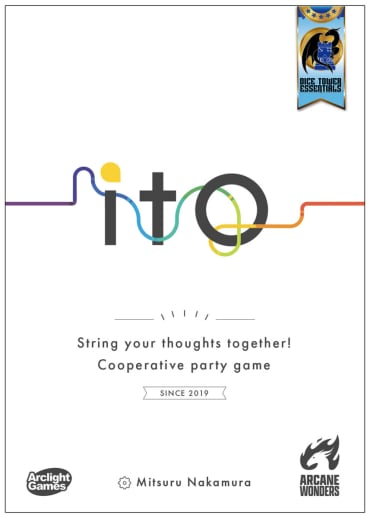
Ito Game

SKU
043168
Grade 3-AD
Teaching Method
Traditional
Teacher-centered curriculum commonly used in classrooms that may include a text, teacher manual, tests, etc.
Charlotte Mason
A methodology based on the work of a 19th century educator who maintained that children learn best from literature (Living Books), not textbooks.
Classical
A methodology based on the Latin Trivium (three stages of learning), including the grammar stage (memorization and facts), logic stage (critical thinking), and rhetoric stage (developing/defending ideas).
Unit Study
A thematic or topical approach centered around one topic that integrates multiple subject areas.
Montessori (Discovery)
A methodology based on the work of a 20th century educator that emphasizes student and sensory-driven discovery learning and real-life applications.
Other
Other methodologies
Religious Content
Secular
Contains content contrary to common Christian beliefs (i.e. evolution).
Neutral
Avoids religious or theoretical topics or presents multiple viewpoints without preference.
Christian/Religious
Faith-based or including instructional religious content.
Learning Modality
Auditory
Learns through listening, talking out loud or reading out loud.
Visual
Learns through seeing, prefers written instructions and visual materials.
Kinesthetic/Tactile (Hands-On)
Learns through moving, doing and touching.
Multi-Sensory
Curriculum that employ a variety of activities/components.
Presentation
Sequential
Curriculum progresses through well-defined learning objectives. Emphasizes mastery before moving to the next topic.
Spiral
Topics and concepts are repeated from level to level, adding more depth at each pass and connecting with review.
Conceptual/Topical
Focus is on the “why,” often with a unifying concept as well as specific skills; coverage may be broader.
Teacher Involvement
Low Teacher Involvement
Student-led materials; parent acts as a facilitator.
Medium Teacher Involvement
A mix of teacher-led time and independent student work.
High Teacher Involvement
Teacher-led lessons; may utilize discussions, hands-on activities and working together.
Additional Materials Required
No other materials needed
Everything you need is included.
Other Materials Required
There are additional required resources that are a separate purchase.
Other Materials Optional
There are additional resources mentioned or recommended but are not absolutely necessary.
Consumable
Consumable
Designed to be written in; not reusable.
Non-Consumable
Not designed to be written in; reusable.
Our Price
$17.99 $17.99 $14.75
Rainbow Savings: $3.24

Product Overview

  • Cooperative party game
  • 2-10 players
  • Plays in 10 minutes
  • Great conversation starter

Description

Ito from Arcane Wonders is a cooperative card game for 2-10 people and the perfect choice for family and party groups. The concept is simple but facilitates thought, laughter, and often synchronicity.  Best of all, it takes only 10 minutes per round.  Here is how it works:

There are two decks of cards that drive this game: One has 50 category cards, and the other has cards numbered from 1-100.  Also included is one 0 card. The category cards are two-sided and include three different categories to help customize the game to your group: 1) Everyone cards work for most groups; 2) Family cards play with all ages; and 3) Action cards include physical movement such as singing and sound effects. 

The other card component are the player cards. There are ten 3-card sets of different colors, which are used to mark individual players’ “guesses” during gameplay as explained later in this description. Each player chooses one set.

To set up the game, place the 0 card in the middle of the table and shuffle the number and category card decks. Deal each player one number card, which they keep secret from other players. Draw the top card from the category deck and choose one category on either side of the card to use. 

To illustrate how gameplay works, imagine that the chosen category card is from the “everyone” group and has the following statement: “Things or actions that take bravery.” Imagine there are three people playing. Player 1 has the number 3 card, Player 2 has 10, and Player 3 has 85. Each player takes turns providing an example best matching their number on a scale to 100 and relative to the category statement. Showing a great amount of bravery would signify a higher number, with little bravery being a lower number. As each player gives their example, they place their number card face down in a line that starts with the 0 card and goes to its right, trying to set its placement relative to zero and to other player’s examples.  They also mark their unrevealed number card by placing one of their color-coded cards underneath. Players work together, modifying their hints, but they cannot give any number value–related clues. With the collective goal to put the number cards in the correct order, they may discuss as a group where each number card should be and may make changes to their order. 

Begin the resolution phase by revealing each card starting from zero. If all the cards are in the right order, the player group wins! Using the above category of bravery, a win might be 3 (crossing a country road), 10 (rolling down a small hill), and 85 (rescuing people from a burning building). The key to this game is being able to give clues relative to each other and number values. When players happen to have number cards that are closer to each other the game becomes more challenging.  Since Ito plays in just 10 minutes per round, it is compelling and fun to play several times!  A personal suggestion is to have at least four players, as Ito is at its best in larger groups, both for gameplay and the compelling conversations it elicits! ~ Marsha

Publisher's Description of Ito Game
String your thoughts together!

ito is a cooperative game where you and your friends will each get your own secret number you then have to try to put in order as a group based on the clues you give related to the chosen theme.

At the start of the game, each player gets a secret number card that can have a value between 1 and 100. Remember, it’s a SECRET, so of course the other players can’t tell you directly what number they have, and neither can you!

The trick is for everyone to understand their intentions just by hearing theme-based clues. Do you and your friends see eye to eye in how you view the world? Have fun finding out in this exciting party game!

  • Each player chooses a color and takes the three Player Cards of that color. The rest are returned to the box.
  • Shuffle the Category Cards to create a deck.
  • Shuffle the Number Cards to create a deck.
  • Place the Zero Card in the middle of the table leaving space for players to lay their Number Cards in the Playing Space.
  • Deal a Number Card to each player. Players may look at their own card, but should not reveal their card to any other players.
  • Draw the top card of the Category Deck and as a group choose which of the categories (front or back of the card) to play this round.
Every player must provide an example related to the chosen category which hints towards the number they hold in their hand. This can be done freely among the players without a strict turn order. When you have your hint, play the card into the Playing Space, placing it either next to the zero (if you played first), immediately to the right of the previous card played, or in-between two cards that have been played creating a thread with no breaks.
You may not include numbers, values or quantities in your hint — and, of course, you can’t show your card or reveal its value!
The objective is for all players to arrange the cards in a row starting from the Zero card, in numerical order lowest to highest. Closer to the Zero card means a lower number. When you play a card in the row, place one of your Player Cards face up under the Number Card to mark it as yours.
Discuss as a group where each card belongs in the thread, changing the order of a card if needed. When everyone has agreed on the order of the cards, the resolution phase begins. Starting from 0, reveal each card one by one. If all the cards are in correct numerical order, lowest to highest, you win!
Category Description for Cooperative Games

We play a lot of board games in our family - mostly competitive ones! However, it's nice to switch up game night and play a cooperative game where all of the players are working together toward a goal, collectively save the world, or solve a mystery. Cooperative games foster team spirit and give players a chance to use their individual talents as everyone works toward achieving a goal. If you haven't tried this alternative to playing together, here's an assortment of cooperative games for all ages. 

Details
More Information
Product Format:Other
Grades:3-AD
Brand:Arcane Wonders
EAN/UPC:850039564574
Length in Inches:5.5
Width in Inches:4
Height in Inches:1.625
Weight in Pounds:0.9
Videos
This product doesn't have a video
Reviews
Product Q&A