
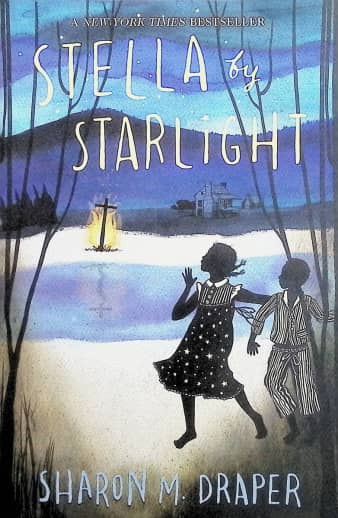
Set in the segregated South in the 1930s, this middle-school historical fiction novel follows a young girl, Stella, who dreams of being a writer, and her family as danger breaches her small town. One night, Stella sees a glimpse of the KKK behind the lake, and it is only the beginning of the change about to come. When Stella’s father decides he’s going to register to vote, trouble that has been brewing begins to spill over into her community. Emphasizing the power and importance of community and friendship, this book gives readers a chance to see through Stella’s eyes as she fights for what is right. She is a noble main character, kind and courageous, and an inspiration to readers young and old. Though some violent events are depicted in this novel, nothing is graphic, and the majority of the book centers on Stella’s family. Includes a reading guide with discussion questions in the back. 336 pgs, pb.
Stella by Starlight by Sharon M. Draper
SKU
043166
ISBN
9781442494985
Grade 4-8
These icons are designed to help you quickly understand and learn important information about our products.
Teaching Method
Traditional
Teacher-centered curriculum commonly used in classrooms that may include a text, teacher manual, tests, etc.
Charlotte Mason
A methodology based on the work of a 19th century educator who maintained that children learn best from literature (Living Books), not textbooks.
Classical
A methodology based on the Latin Trivium (three stages of learning), including the grammar stage (memorization and facts), logic stage (critical thinking), and rhetoric stage (developing/defending ideas).
Unit Study
A thematic or topical approach centered around one topic that integrates multiple subject areas.
Montessori (Discovery)
A methodology based on the work of a 20th century educator that emphasizes student and sensory-driven discovery learning and real-life applications.
Other
Other methodologies
Religious Content
Secular
Contains content contrary to common Christian beliefs (i.e. evolution).
Neutral
Avoids religious or theoretical topics or presents multiple viewpoints without preference.
Christian/Religious
Faith-based or including instructional religious content.
Learning Modality
Auditory
Learns through listening, talking out loud or reading out loud.
Visual
Learns through seeing, prefers written instructions and visual materials.
Kinesthetic/Tactile (Hands-On)
Learns through moving, doing and touching.
Multi-Sensory
Curriculum that employ a variety of activities/components.
Presentation
Sequential
Curriculum progresses through well-defined learning objectives. Emphasizes mastery before moving to the next topic.
Spiral
Topics and concepts are repeated from level to level, adding more depth at each pass and connecting with review.
Conceptual/Topical
Focus is on the “why,” often with a unifying concept as well as specific skills; coverage may be broader.
Teacher Involvement
Low Teacher Involvement
Student-led materials; parent acts as a facilitator.
Medium Teacher Involvement
A mix of teacher-led time and independent student work.
High Teacher Involvement
Teacher-led lessons; may utilize discussions, hands-on activities and working together.
Additional Materials Required
No other materials needed
Everything you need is included.
Other Materials Required
There are additional required resources that are a separate purchase.
Other Materials Optional
There are additional resources mentioned or recommended but are not absolutely necessary.
Consumable
Consumable
Designed to be written in; not reusable.
Non-Consumable
Not designed to be written in; reusable.
Our Price
$9.99 $9.99 $7.50
Rainbow Savings: $2.49
Product Overview
- Meet Stella, a young Black girl living in the segregated South in the 1930s, whose life changes after she catches a glimpse of something terrible
- Emphasizes the importance of community and standing up for what’s right
- Though there are violent events depicted, there is nothing graphic
- Reading guide with discussion questions included
Description
Publisher's Description of Stella by Starlight by Sharon M. Draper
Stella lives in the segregated South—in Bumblebee, North Carolina, to be
exact about it. Some stores she can go into. Some stores she can’t.
Some folks are right pleasant. Others are a lot less so. To Stella, it
sort of evens out, and heck, the Klan hasn’t bothered them for years.
But one late night, later than she should ever be up, much less
wandering around outside, Stella and her little brother see something
they’re never supposed to see, something that is the first flicker of
change to come, unwelcome change by any stretch of the imagination. As
Stella’s community—her world—is upended, she decides to fight fire with
fire. And she learns that ashes don’t necessarily signify an end.
Details
| Product Format: | Paperback |
|---|---|
| Grades: | 4-8 |
| Brand: | Atheneum |
| Author: | Sharon Draper |
| ISBN: | 9781442494985 |
| Length in Inches: | 7.625 |
| Width in Inches: | 5.125 |
| Height in Inches: | 0.875 |
| Weight in Pounds: | 0.55 |
Videos
Reviews