These icons are designed to help you quickly understand and learn important information about our products.
Teaching Method
Traditional
Teacher-centered curriculum commonly used in classrooms that may include a text, teacher manual, tests, etc.
Charlotte Mason
A methodology based on the work of a 19th century educator who maintained that children learn best from literature (Living Books), not textbooks.
Classical
A methodology based on the Latin Trivium (three stages of learning), including the grammar stage (memorization and facts), logic stage (critical thinking), and rhetoric stage (developing/defending ideas).
Unit Study
A thematic or topical approach centered around one topic that integrates multiple subject areas.
Montessori (Discovery)
A methodology based on the work of a 20th century educator that emphasizes student and sensory-driven discovery learning and real-life applications.
Other
Other methodologies
Religious Content
Secular
Contains content contrary to common Christian beliefs (i.e. evolution).
Neutral
Avoids religious or theoretical topics or presents multiple viewpoints without preference.
Christian/Religious
Faith-based or including instructional religious content.
Learning Modality
Auditory
Learns through listening, talking out loud or reading out loud.
Visual
Learns through seeing, prefers written instructions and visual materials.
Kinesthetic/Tactile (Hands-On)
Learns through moving, doing and touching.
Multi-Sensory
Curriculum that employ a variety of activities/components.
Presentation
Sequential
Curriculum progresses through well-defined learning objectives. Emphasizes mastery before moving to the next topic.
Spiral
Topics and concepts are repeated from level to level, adding more depth at each pass and connecting with review.
Conceptual/Topical
Focus is on the “why,” often with a unifying concept as well as specific skills; coverage may be broader.
Teacher Involvement
Low Teacher Involvement
Student-led materials; parent acts as a facilitator.
Medium Teacher Involvement
A mix of teacher-led time and independent student work.
High Teacher Involvement
Teacher-led lessons; may utilize discussions, hands-on activities and working together.
Additional Materials Required
No other materials needed
Everything you need is included.
Other Materials Required
There are additional required resources that are a separate purchase.
Other Materials Optional
There are additional resources mentioned or recommended but are not absolutely necessary.
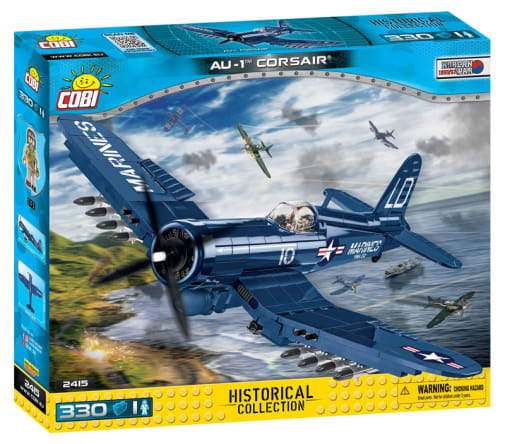
The VOUGHT AU-1™ Corsair® was a fighter aircraft of the United States Navy. It was produced between 1942 and 1952 by Vought-Sikorsky Aircraft. The popular Corsair entered service in 1942. The distinctive shape of the bent wings and the rearward-shifted pilot's cabin and propeller with a diameter of more than 4 meters made it one-of-a-kind. The long operation of the constantly improved Corsairs began to come to an end with the advent of jet aircraft. Corsairs took an active part in the Korean War, where they ceased to play an important role as fighter jets but they worked very well as support aircraft. Since 1952, Corsairs bearing the symbol AU-1 had entered the U.S. Navy. The letter "A" in the name meant support aircraft. The aircraft were armed with four 20mm cannons located on the wings. A new advent was the hooks used for hanging rockets and bombs. The Corsair was also able to carry about 1,815 kg of combat payload.The COBI Corsair kit – set number 2415 - was developed under license from the American mega defense technology company Northrop Grumman. The AU-1™ Corsair® contains 330 COBI blocks and one pilot figure. The model of the fighter aircraft from COBI was created with attention to the smallest details. The aircraft has a movable propeller and fins. Its rotating wheels with rubber tires can be extended from the chassis in the take-off or landing position. The wings are folded in a way that is characteristic of this aircraft. Block hooks allow you to attach rockets, as well. The cabin can be opened to place the pilot figure at the controls. The aircraft has been covered with high-quality prints that do not scratch or smear even during intense fun. In this set stickers have been completely abandoned. The prints reproduce the painting and equipment of the Korean war aircraft.A special stand is also included to enhance the model's display and aircraft name plate.
330 high-quality components
Manufactured in the EU by a company with more than 20 years of tradition
Meets safety standards for children's products
Fully compatible with other brands of building blocks
Blocks with prints do not scratch or smear and do not fade during play or under the influence of temperature
100% prints, no stickers
Easy-to-read and intuitive instruction based on illustrations and step-by-step directions
Special display stand
1 pilot figure
Model dimensions (length x width x height): 27 cm (10.6") x 33.5 cm (12.6") x 12 cm (4.7")
The COBI World War IIHistorical Series sets feature tanks, aircraft, ships, and other vehicles of both sides of combat. Each set includes one or more characters which match the theme and ranking of the vehicle. Depending on the model, individual sets each feature various moving components such as gun barrels, turrets, tracks, wings, propellers, engine compartments, and more.