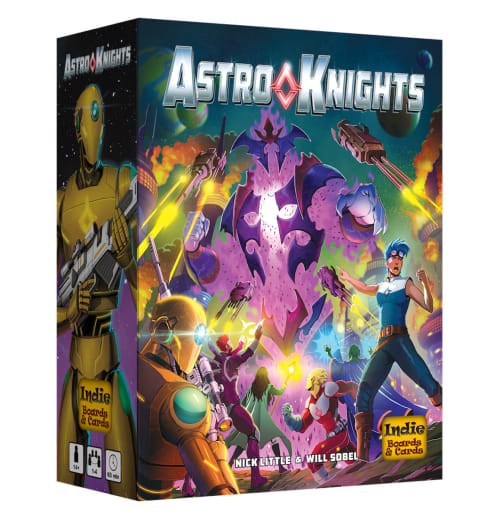
Play solo or work cooperatively as Astro Knight Heroes with up to four people to defend your homeworld—and each other—against different boss monsters in this deck-building game using powers, weapons, and technology to plan and equip each turn’s offensive and defensive moves.
Who are the Astro Knights and how do they fight? These knights are heroes named Silas, Christina, Nasma, Gavril, Toli, and Z.A.K. They each have a unique ability that can be activated when it is powered up. There are four homeworld cards to choose from, and each homeworld starts with a specified number of lives.
The heroes each start with 10 lives and one slot to carry weapons. The power and strategy are in the cards. Each player starts with a unique hand and can use their energy to buy more powerful cards to build their deck. There are three types of cards: (1) Fuel – These are used to gain energy that can be spent on cards, to power up your special ability, or to increase its weapon capacity slot; (2) Tech – These cards have instant effects and abilities; and (3) Weapon – The main way to deal damage to the Boss and its Minions.
What about the Bosses? There are 4 bosses with different difficulty levels, and they also start at different levels of health. They each have their own rules and their own deck of cards that levels up throughout the game , so the Knights (heroes) will need different offense and defense strategies to beat them. The bosses’ goal is to destroy all heroes and their homeworld before they themselves are destroyed.
Turn order is unique in this game, as it is determined by a set of turn-order cards that are shuffled each time the deck runs out. This means it is randomized and unknown until each card is drawn. The game ends and the boss loses if it has 0 health after a hero attack. The players lose if they all reach 0 health, their homeworld has 0 health, or the Boss deck is at its final level and its draw deck is empty.
Although there is a measure of luck with the randomization of turn order, there are important decisions to make with the use of energy resources, which cards to purchase, and how to influence the order cards are drawn in following turns. Working together as a team to help share resources and fend off attacks is key. At times, the boss’s minions should be conquered before attacking the boss because they activate each of their turns and they can destroy power and energy for the boss team as well as their homeworld. Astro Knights has an approximate 60-minute game time, depending on the number of players. - - Marsha
Astro Knights Game
SKU
037220
Grade 9-AD
These icons are designed to help you quickly understand and learn important information about our products.
Teaching Method
Traditional
Teacher-centered curriculum commonly used in classrooms that may include a text, teacher manual, tests, etc.
Charlotte Mason
A methodology based on the work of a 19th century educator who maintained that children learn best from literature (Living Books), not textbooks.
Classical
A methodology based on the Latin Trivium (three stages of learning), including the grammar stage (memorization and facts), logic stage (critical thinking), and rhetoric stage (developing/defending ideas).
Unit Study
A thematic or topical approach centered around one topic that integrates multiple subject areas.
Montessori (Discovery)
A methodology based on the work of a 20th century educator that emphasizes student and sensory-driven discovery learning and real-life applications.
Other
Other methodologies
Religious Content
Secular
Contains content contrary to common Christian beliefs (i.e. evolution).
Neutral
Avoids religious or theoretical topics or presents multiple viewpoints without preference.
Christian/Religious
Faith-based or including instructional religious content.
Learning Modality
Auditory
Learns through listening, talking out loud or reading out loud.
Visual
Learns through seeing, prefers written instructions and visual materials.
Kinesthetic/Tactile (Hands-On)
Learns through moving, doing and touching.
Multi-Sensory
Curriculum that employ a variety of activities/components.
Presentation
Sequential
Curriculum progresses through well-defined learning objectives. Emphasizes mastery before moving to the next topic.
Spiral
Topics and concepts are repeated from level to level, adding more depth at each pass and connecting with review.
Conceptual/Topical
Focus is on the “why,” often with a unifying concept as well as specific skills; coverage may be broader.
Teacher Involvement
Low Teacher Involvement
Student-led materials; parent acts as a facilitator.
Medium Teacher Involvement
A mix of teacher-led time and independent student work.
High Teacher Involvement
Teacher-led lessons; may utilize discussions, hands-on activities and working together.
Additional Materials Required
No other materials needed
Everything you need is included.
Other Materials Required
There are additional required resources that are a separate purchase.
Other Materials Optional
There are additional resources mentioned or recommended but are not absolutely necessary.
Consumable
Consumable
Designed to be written in; not reusable.
Non-Consumable
Not designed to be written in; reusable.
Our Price
$49.99 $49.99 $42.95
Rainbow Savings: $7.04
Description
Details
| Product Format: | Other |
|---|---|
| Grades: | 9-AD |
| Brand: | Indie Board & Cards |
| EAN/UPC: | 810017900305 |
| Length in Inches: | 9.875 |
| Width in Inches: | 7.875 |
| Height in Inches: | 3.625 |
| Weight in Pounds: | 3.15 |
Videos
Reviews