
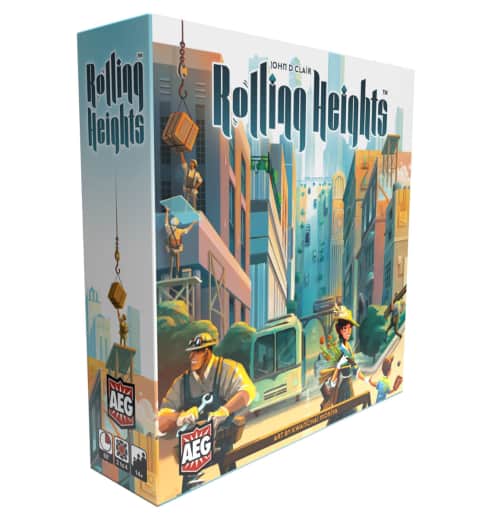
Rolling Heights Game

SKU
037201
Grade 9-AD
Teaching Method
Traditional
Teacher-centered curriculum commonly used in classrooms that may include a text, teacher manual, tests, etc.
Charlotte Mason
A methodology based on the work of a 19th century educator who maintained that children learn best from literature (Living Books), not textbooks.
Classical
A methodology based on the Latin Trivium (three stages of learning), including the grammar stage (memorization and facts), logic stage (critical thinking), and rhetoric stage (developing/defending ideas).
Unit Study
A thematic or topical approach centered around one topic that integrates multiple subject areas.
Montessori (Discovery)
A methodology based on the work of a 20th century educator that emphasizes student and sensory-driven discovery learning and real-life applications.
Other
Other methodologies
Religious Content
Secular
Contains content contrary to common Christian beliefs (i.e. evolution).
Neutral
Avoids religious or theoretical topics or presents multiple viewpoints without preference.
Christian/Religious
Faith-based or including instructional religious content.
Learning Modality
Auditory
Learns through listening, talking out loud or reading out loud.
Visual
Learns through seeing, prefers written instructions and visual materials.
Kinesthetic/Tactile (Hands-On)
Learns through moving, doing and touching.
Multi-Sensory
Curriculum that employ a variety of activities/components.
Presentation
Sequential
Curriculum progresses through well-defined learning objectives. Emphasizes mastery before moving to the next topic.
Spiral
Topics and concepts are repeated from level to level, adding more depth at each pass and connecting with review.
Conceptual/Topical
Focus is on the “why,” often with a unifying concept as well as specific skills; coverage may be broader.
Teacher Involvement
Low Teacher Involvement
Student-led materials; parent acts as a facilitator.
Medium Teacher Involvement
A mix of teacher-led time and independent student work.
High Teacher Involvement
Teacher-led lessons; may utilize discussions, hands-on activities and working together.
Additional Materials Required
No other materials needed
Everything you need is included.
Other Materials Required
There are additional required resources that are a separate purchase.
Other Materials Optional
There are additional resources mentioned or recommended but are not absolutely necessary.
Consumable
Consumable
Designed to be written in; not reusable.
Non-Consumable
Not designed to be written in; reusable.
Our Price
$79.99 $79.99 $68.95
Rainbow Savings: $11.04

Description

Good city planning takes more than acres of available surveyed lots.  In this game, you assume the role of a building contractor in the 1920s.  To be successful you need planning, hiring, and management skills to obtain the right workers and procure the materials needed for different types of buildings to create a thriving community.  Rolling Heights is a city-building game containing elements of area control and push-your-luck mechanics with the goal of earning the most victory points to win the game.
There are nine different colored meeples in this game, which represent either a matching building cube or a designated action.  Each turn, players roll their meeple workers to determine which materials they gain and actions they can take.  Standing meeples work hard that day and provide actions that are more powerful or two building materials in their matching color.  Meeples that lay on their sides are working steady and provide less powerful actions or one building material.  Facedown meeples are exhausted and provide nothing.  You can push your luck for better rolls, but you might lose valuable materials you need to construct new buildings if you re-roll remaining meeples and they all land face-down.
Players may take next any of the following actions in any order:
  1. Activate meeples and take building materials or actions that match that color meeple and their level of work state (working hard or working steady).   Building cubes are either steel (blue), wood (tan), concrete (grey), or glass (white).  The meeples that provide actions are yellow, magenta, purple, pink, and green.  For example, the pink meeple lets players roll all exhausted workers once more while the yellow meeple grants prestige points.
  2. Purchase additional building plans and place them on the map.  Only one plan is available for purchase per turn.  There are two different levels of tiles, which both display nine different available tiles and their purchase cost.  Level 1 tiles start at a cost of one cube of any color and level II starts at a cost of two cubes of any color.  
  3. Building plan tiles belong to any of the following categories:  Parks, Civic Buildings, Residential, Commercial, and Industrial.  Before purchase, players should decide where the building plan they choose can be placed and make sure they have the cubes to pay for both the plan and any additional costs for placement, if necessary.  Some available plots are marked for specific building types.  After placement, mark the plan with a matching token of your player color to designate ownership.
  4. Use wild tokens to obtain one building material of choice per token.  
  5. Make commodity trades by trading two cubes for any other cube.
  6. Construct buildings using your steel, glass, wood and cement cubes on any unfinished matching building plans
  7. Finish buildings:  Once a building has all of its required cubes on it, immediately score any victory points on the tile by advancing your player token on the score track.  Also, take any meeple worker rewards and place your ownership marker on one of the cube stacks.
Once any of the above actions that you wish or are able to take are complete, return any unused cubes to the supply and place all meeples in your rolling box for the next turn.  Replace any building plan tiles and your turn is complete.
Besides earning victory points for completed buildings, there are three common goals that are revealed at the beginning of the game as well as individual goals that are scored at the end of the game.  Once all cubes of any one color are gone, the current round and one additional round are completed and the player with the most points wins!
Rolling Heights has a unique mechanic, clever design, and great variety between games, as well as beautifully made components and a clearly written rulebook.  I look forward to playing this game again!  For 1-4 players with a 60+ minute playtime, depending on player count. - - - Marsha

Publisher's Description of Rolling Heights Game
It's the 1920's and your career as a general contractor is about to take off. You have just started your business in a rapidly expanding city.

In Rolling Heights, players roll workers in the form of meeples. Standing meeples work hard that day and provide special actions and building materials, while face-down meeples provide nothing. You can always push your luck for better rolls, but you might lose valuable materials you need to construct new buildings. Completing buildings gains you prestige, as well as new workers to help you construct even larger buildings, including skyscrapers.
  • 2-4 players
  • Ages 14+
  • 60 minute play time
Contents:
  • 6 double-Sided Neighborhood Boards
  • 1 Score Board
  • 2 Market Strips
  • 78 Building Plans
  • 1 Start Player Token
  • 98 Meeples
  • 285 Stackable cubes (Building pieces)
  • 4 Player Tokens
  • 4 Rolling boxes
  • 72 Ownership Markers
  • 12 Ad Tiles
  • 13 Target Tiles
  • 30 Wild Tokens
Details
More Information
Product Format:Other
Grades:9-AD
Brand:Alderac Entertainment Group
EAN/UPC:729220070852
Length in Inches:11.75
Width in Inches:11.75
Height in Inches:3.25
Weight in Pounds:4.75
Videos
Reviews
Product Q&A