
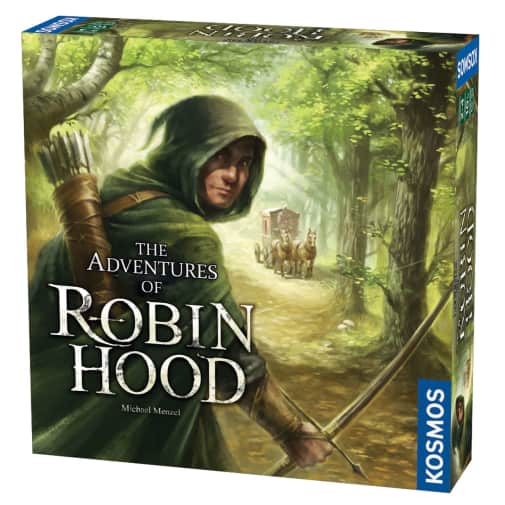
Have you watched a Robin Hood movie or read The Merry Adventures of Robin Hood? In this cooperative storytelling game, up to four players can experience the story and participate in an adventure that spans a wonderfully written 200-page book, which guides you through the game. There are 7 chapters—each of which builds on the choices made during gameplay in previous chapters.
How does this all work within a board game, what are the components and mechanisms used, and how do characters move and interact to carry out tasks that contribute to this adventure? There are several methods used within the game components and narrative that tie the stories and gameplay together in a fun and effective way.
Components and Game Flow:
- Game Board: Make sure you have space for this board (21” x 38”), which comes in 8 pieces to put together like a jigsaw puzzle and is the setting that your characters move through while interacting with the story. The dominant areas on this board are Sherwood Forest and its clearings and the Castle and its grounds. There are numerous tabs of different shapes and types located throughout the board. During the game, as the stories unfold, players will flip them over to discover items and challenges underneath.
- Story Book: The game includes a starter sheet, which assists with game setup, and gives some basic instructions. Players are then instructed to open the book and start their first adventure! In the first story, you are asked to flip over a tile that is located in the castle courtyard, which contains a palace guard that captures Little John. Robin Hood starts in the forest. If there are additional players, Maid Marian and Will Scarlet are added to the story. Continue to read the book and follow its instructions until you meet a challenge that decides whether you win or lose the first chapter’s task. Once the chapter ends, you may replay or continue to the next chapter. Each chapter ends at a good stopping point if players wish to end their game session and pick it up at another time.
- Character Pieces: Each character’s player set is wooden and contains two standing characters and three other pieces that are used to move characters on the board. Also included are matching colored discs for each player that are put into the included cloth bag. The discs are used to determine turn order during each round of the story. Besides the character discs, there are red and gray discs that may be drawn. Red always triggers bad events, and gray allows any player of your choice to take an additional turn that round. When all the discs are drawn and each player’s actions are read from the storybook, that round ends and the next round begins.
- Additional Components: The other meaningful components used in this game are different colored cubes, red hourglasses, and a red bard figure. The colored cubes are put into the cloth draw bag along with the character discs. Different events cause specific colored cubes to be added to the bag or drawn out to determine the outcome of events. Some examples include when a white cube is drawn, a guard is defeated, or when a red cube is drawn, the Sheriff character on the board might move closer to a targeted player or location, potentially putting them at a disadvantage.
At the bottom of the main board is a banner of hope track that goes from 0-18. The bard figure starts at the top of the track at space 18, the rightmost space. At the far left or “bad end” of the track, there is an illustration of a storybook. During the story, players are directed to place a specific number of hourglasses there. When hourglasses are lost or bad events occur, the bard moves to the left. If players successfully complete their winning assignment before all hourglasses are removed, they win the round, and if the hourglasses are removed before they complete the mission, they lose.
Mechanisms:
There are 7 chapters in the game, which branch out after chapter 4 based on choices and outcomes during previous gameplay. As mentioned, the entire game flow is determined by the storybook, but character choices and actions affect the narrative and outcomes. Each character decides where they move and where they explore on the game board. However, the order in which characters take turns and have success in combat and other challenges presented are also determined by luck with the colors of cubes placed in and drawn from the cloth bag. Overall, this game can be a rewarding experience for 2-4 players working together to explore and participate in the story. Each chapter takes about 60 minutes to play, can be replayed, and the entire game resets easily to start over. I have only played one chapter and lost, but I would love to return and either move forward or start over. ~ Marsha