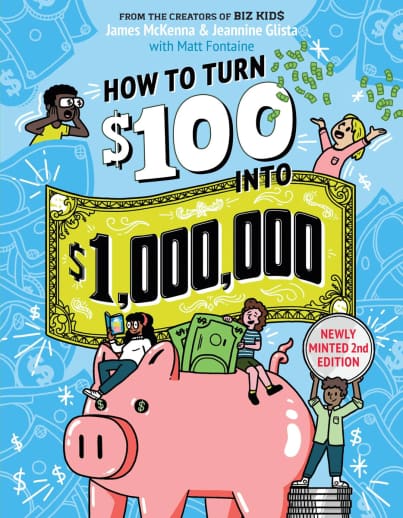
This may sound too good to be true, but I loved how this book encourages kids to think about why they want a million dollars. The presentation of the content is great! It makes complicated things like investments sound friendly and realistic. Kids are starting businesses and making their own money all the time these days. What a valuable resource to teach them how to grow that money for later. Good character is stressed throughout this easy-to-read format. sc, 133pp. ~ Sara
How to Turn $100 Into $1,000,000 2nd Edition
SKU
031158
ISBN
9781523523436
Grade 4-8
These icons are designed to help you quickly understand and learn important information about our products.
Teaching Method
Traditional
Teacher-centered curriculum commonly used in classrooms that may include a text, teacher manual, tests, etc.
Charlotte Mason
A methodology based on the work of a 19th century educator who maintained that children learn best from literature (Living Books), not textbooks.
Classical
A methodology based on the Latin Trivium (three stages of learning), including the grammar stage (memorization and facts), logic stage (critical thinking), and rhetoric stage (developing/defending ideas).
Unit Study
A thematic or topical approach centered around one topic that integrates multiple subject areas.
Montessori (Discovery)
A methodology based on the work of a 20th century educator that emphasizes student and sensory-driven discovery learning and real-life applications.
Other
Other methodologies
Religious Content
Secular
Contains content contrary to common Christian beliefs (i.e. evolution).
Neutral
Avoids religious or theoretical topics or presents multiple viewpoints without preference.
Christian/Religious
Faith-based or including instructional religious content.
Learning Modality
Auditory
Learns through listening, talking out loud or reading out loud.
Visual
Learns through seeing, prefers written instructions and visual materials.
Kinesthetic/Tactile (Hands-On)
Learns through moving, doing and touching.
Multi-Sensory
Curriculum that employ a variety of activities/components.
Presentation
Sequential
Curriculum progresses through well-defined learning objectives. Emphasizes mastery before moving to the next topic.
Spiral
Topics and concepts are repeated from level to level, adding more depth at each pass and connecting with review.
Conceptual/Topical
Focus is on the “why,” often with a unifying concept as well as specific skills; coverage may be broader.
Teacher Involvement
Low Teacher Involvement
Student-led materials; parent acts as a facilitator.
Medium Teacher Involvement
A mix of teacher-led time and independent student work.
High Teacher Involvement
Teacher-led lessons; may utilize discussions, hands-on activities and working together.
Additional Materials Required
No other materials needed
Everything you need is included.
Other Materials Required
There are additional required resources that are a separate purchase.
Other Materials Optional
There are additional resources mentioned or recommended but are not absolutely necessary.
Consumable
Consumable
Designed to be written in; not reusable.
Non-Consumable
Not designed to be written in; reusable.
Our Price
$13.99 $13.99 $9.95
Rainbow Savings: $4.04
Description
Publisher's Description of How to Turn $100 Into $1,000,000 2nd Edition
The bestselling kids’ guide to money: how to EARN it, SAVE it, and INVEST it.
From the creators of Biz Kid$ and Bill Nye the Science Guy comes a new edition with everything a kid needs to know to become a millionaire (or billionaire!) Learn the basics of earning, saving, spending, and investing money in this fun, easy to read, and informative book.
From creating a resume and starting your first job, to navigating the stock market and investing in Bitcoin, How to Turn $100 Into $1,000,000 is essential reading for kids who want to feel financially empowered and learn good money-making decisions. With inspiration from self-made millionaires, stories of entrepreneurial kids, and templates to make your very own business plan, this book is bursting with everything a kid could need to turn $100 into so much more.
The key to making money is to start saving as soon as possible, and what better place to start than right here!
Details
| Product Format: | Paperback |
|---|---|
| Grades: | 4-8 |
| Brand: | Workman Publishing Company |
| ISBN: | 9781523523436 |
| Length in Inches: | 9.125 |
| Width in Inches: | 7.125 |
| Height in Inches: | 0.375 |
| Weight in Pounds: | 0.8 |
Videos
Reviews