
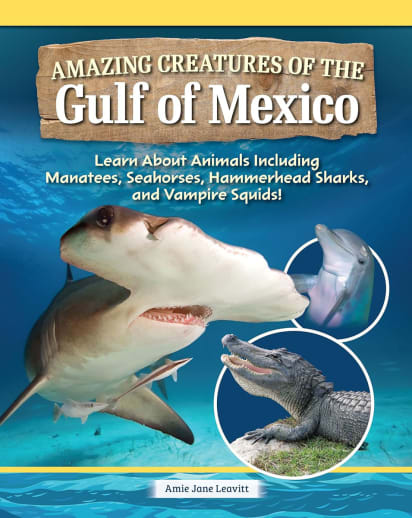
Dive beneath the surface of the Gulf of Mexico and explore all the life below! With the turn of each page, encounter full-color photographs of these marvelous creatures accompanied by educational captions and fun facts. From manatees to vampire squids to pelicans to sperm whales, there is so much to learn about these fascinating animals. If the last page hasn’t fully satiated your curiosity, there is a list of further resources in the back. For any readers who may have stumbled over unfamiliar terminology, a glossary helps expand vocabulary. An index makes topics easily accessible. 32 pgs, pb.
Amazing Creatures of the Gulf of Mexico
SKU
030784
ISBN
9798890941688
Grade PK-5
These icons are designed to help you quickly understand and learn important information about our products.
Teaching Method
Traditional
Teacher-centered curriculum commonly used in classrooms that may include a text, teacher manual, tests, etc.
Charlotte Mason
A methodology based on the work of a 19th century educator who maintained that children learn best from literature (Living Books), not textbooks.
Classical
A methodology based on the Latin Trivium (three stages of learning), including the grammar stage (memorization and facts), logic stage (critical thinking), and rhetoric stage (developing/defending ideas).
Unit Study
A thematic or topical approach centered around one topic that integrates multiple subject areas.
Montessori (Discovery)
A methodology based on the work of a 20th century educator that emphasizes student and sensory-driven discovery learning and real-life applications.
Other
Other methodologies
Religious Content
Secular
Contains content contrary to common Christian beliefs (i.e. evolution).
Neutral
Avoids religious or theoretical topics or presents multiple viewpoints without preference.
Christian/Religious
Faith-based or including instructional religious content.
Learning Modality
Auditory
Learns through listening, talking out loud or reading out loud.
Visual
Learns through seeing, prefers written instructions and visual materials.
Kinesthetic/Tactile (Hands-On)
Learns through moving, doing and touching.
Multi-Sensory
Curriculum that employ a variety of activities/components.
Presentation
Sequential
Curriculum progresses through well-defined learning objectives. Emphasizes mastery before moving to the next topic.
Spiral
Topics and concepts are repeated from level to level, adding more depth at each pass and connecting with review.
Conceptual/Topical
Focus is on the “why,” often with a unifying concept as well as specific skills; coverage may be broader.
Teacher Involvement
Low Teacher Involvement
Student-led materials; parent acts as a facilitator.
Medium Teacher Involvement
A mix of teacher-led time and independent student work.
High Teacher Involvement
Teacher-led lessons; may utilize discussions, hands-on activities and working together.
Additional Materials Required
No other materials needed
Everything you need is included.
Other Materials Required
There are additional required resources that are a separate purchase.
Other Materials Optional
There are additional resources mentioned or recommended but are not absolutely necessary.
Consumable
Consumable
Designed to be written in; not reusable.
Non-Consumable
Not designed to be written in; reusable.
Our Price
$7.99 $7.99 $7.25
Rainbow Savings: $0.74
Product Overview
- Discover the vibrant life that exists within the waters of the Gulf of Mexico!
- Full-color photographs and well-written text make this book captivating and intriguing
- Learn about manatees, vampire squids, hammerhead sharks, sperm whales, and much, much more
- Includes a list of further resources, a glossary, and an index
Description
Publisher's Description of Amazing Creatures of the Gulf of Mexico
The Gulf of Mexico is shaped like a horseshoe. Manatees live along the coasts of the Gulf of Mexico. There are more than 750 known shipwrecks in the Gulf of Mexico. These are just a few of the amazing facts in Life in the Gulf of Mexico. This educational exploration book invites young readers, grades 1-4, to learn about the sea creatures who make their home in the Gulf of Mexico, its topography, and vegetation through vibrant photography and captions. Content includes further reading and web site recommendations, as well as a glossary of terms and index.
Category Description for Amazing / Awesome Creatures of the Ocean
Dive beneath the surface and discover the life beneath! Whether the Arctic Ocean, Atlantic Ocean, or the Gulf of Mexico, there are so many creatures that call these waters home and these books make learning about them accessible, easy, and fun. Full-color photographs are accompanied by educational captions and fun fact tidbits. For the reader who desires to go deeper, a Further Resources section at the end provides recommendations for books and websites to peruse, and an index makes finding a topic easy. For the reader who may have encountered an unfamiliar word or two, a helpful glossary provides definitions. From polar bears to sea turtles to hammerhead sharks, these books bring information about your favorite marine life right to your fingertips.
Details
| Product Format: | Paperback Book |
|---|---|
| Grades: | PK-5 |
| Brand: | Curious Fox Books |
| ISBN: | 9798890941688 |
| Length in Inches: | 9.5 |
| Width in Inches: | 7.5 |
| Height in Inches: | 0.125 |
| Weight in Pounds: | 0.3 |
Videos
Reviews