
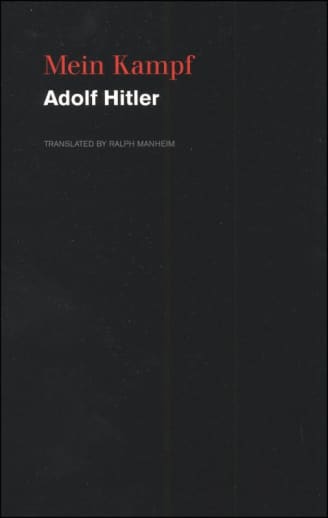
When Adolf Hitler wrote his now-famous (or infamous?) work, most of the world did not give it much notice, or take his ideas very seriously. This was in the mid 1920's, while he became chairman of the relatively small German Worker's Party (later the Nazi party). At that point in time, nobody would have guessed that this man would be leader of a powerful country. He wrote his 694-page tome both to express his unsavory ideals and to remake himself, though writing, into the "savior" of Germany that he was coming to believe that he was. The book contained an autobiography of his life, an analysis of World War I, a critique of Marxism, his ideas on Aryan supremacy, a critique of Communism, and his hatred of Jews. If World War II and the Holocaust had never happened, we might look at his hefty but badly-written work filled with illogical arguments, rambling attempts to hide uneducated thought, sudden outbursts of angry speech, and deliberate attempts to "rewrite" the past as humorous. However, somehow this crazed megalomaniac was able to bring himself to power and put into action his vague, in-concrete ideals in a series of unthinkable atrocities that still haunt us today. Today, this book is valuable for remembrance of that time, to give us a unique perspective on what life was like in World War II - era Germany, and to help us remember the value of keeping alert for people like Hitler, who may seem harmless but could represent untold danger to the world. A Well Trained Mind recommended resource. - Jess
Mein Kampf
Description
First Semester Primary Books: Westminster Confession of Faith, The Pilgrim's Progress, Of Plymouth Plantation, The Social Contract, Foundational American Documents, Federalist and Anti-Federalist Papers, A Tale of Two Cities.
First Semester Secondary Books: Foxe's Book of Martyrs, Frankenstein, Pride and Prejudice, Gulliver's Travels, Autobiography of Benjamin Franklin, The Pit and the Pendulum, The Adventures of Tom Sawyer.
Second Semester Primary Books: Reflections on the Revolution in France, Uncle Tom's Cabin, Lincoln's Speeches, Slave Narratives, The Communist Manifesto, The Treaty of Versailles, The Great Gatsby, Mein Kampf, Philemon, The Epistles of John, The Epistles of Peter and Jude, Nineteen Eighty-Four, Daniel.
Second Semester Secondary Books: Little Women, The Killer Angels, Christianity and Liberalism, The Old Man and the Sea, Animal Farm, Death of a Salesman, Postmodern Times, How Should We Then Live?
| Product Format: | Binder |
|---|---|
| Grades: | 9-AD |
| Brand: | Houghton Mifflin |
| Author: | Adolf Hitler |
| ISBN: | 9780395925034 |
| Length in Inches: | 8.26 |
| Width in Inches: | 5.473 |
| Height in Inches: | 1.749 |
| Weight in Pounds: | 1.51 |
| Introduced by: | Abraham Foxman and Konrad Heiden |
| Pages: | 720 |
| Publication Date: | 9/1/1998 |
| Translated by: | Ralph Manheim |