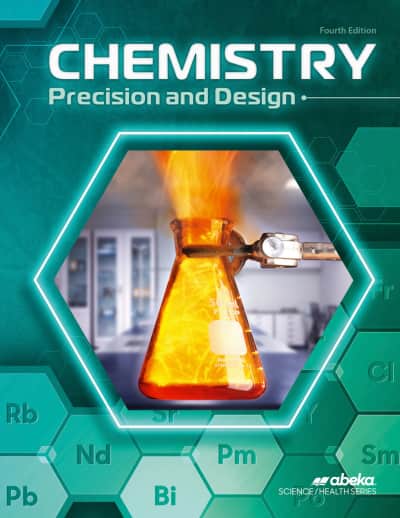
The revised, 4th edition Chemistry: Precision and Design student softcover textbook provides the textual readings, chemistry in everyday life articles, mathematical equations, and the section and chapter reviews. Helpful how to use the text and study tips are included. The text is well illustrated with graphics and colorful photographs throughout to aid student understanding. The appendices provide resource tools including SI prefixes, metric and US units, fundamental constants of nature, unit and temperature conversions, radiation measurement, key symbols, atomic symbols, glossary and index. A periodic table is found inside the back cover.
Abeka Chemistry: Precision and Design Student Textbook (4th Edition)
SKU
028875
ISBN
9781632232090
Grade 11
These icons are designed to help you quickly understand and learn important information about our products.
Teaching Method
Traditional
Teacher-centered curriculum commonly used in classrooms that may include a text, teacher manual, tests, etc.
Charlotte Mason
A methodology based on the work of a 19th century educator who maintained that children learn best from literature (Living Books), not textbooks.
Classical
A methodology based on the Latin Trivium (three stages of learning), including the grammar stage (memorization and facts), logic stage (critical thinking), and rhetoric stage (developing/defending ideas).
Unit Study
A thematic or topical approach centered around one topic that integrates multiple subject areas.
Montessori (Discovery)
A methodology based on the work of a 20th century educator that emphasizes student and sensory-driven discovery learning and real-life applications.
Other
Other methodologies
Religious Content
Secular
Contains content contrary to common Christian beliefs (i.e. evolution).
Neutral
Avoids religious or theoretical topics or presents multiple viewpoints without preference.
Christian/Religious
Faith-based or including instructional religious content.
Learning Modality
Auditory
Learns through listening, talking out loud or reading out loud.
Visual
Learns through seeing, prefers written instructions and visual materials.
Kinesthetic/Tactile (Hands-On)
Learns through moving, doing and touching.
Multi-Sensory
Curriculum that employ a variety of activities/components.
Presentation
Sequential
Curriculum progresses through well-defined learning objectives. Emphasizes mastery before moving to the next topic.
Spiral
Topics and concepts are repeated from level to level, adding more depth at each pass and connecting with review.
Conceptual/Topical
Focus is on the “why,” often with a unifying concept as well as specific skills; coverage may be broader.
Teacher Involvement
Low Teacher Involvement
Student-led materials; parent acts as a facilitator.
Medium Teacher Involvement
A mix of teacher-led time and independent student work.
High Teacher Involvement
Teacher-led lessons; may utilize discussions, hands-on activities and working together.
Additional Materials Required
No other materials needed
Everything you need is included.
Other Materials Required
There are additional required resources that are a separate purchase.
Other Materials Optional
There are additional resources mentioned or recommended but are not absolutely necessary.
Consumable
Consumable
Designed to be written in; not reusable.
Non-Consumable
Not designed to be written in; reusable.
Our Price
$87.00 Product Overview
- Core student text for Abeka’s 11th grade Chemistry Precision and Design
- College preparatory course from a conservative biblical worldview
- Included in the Chemistry Homeschool Student Kit
Description
Publisher's Description of Abeka Chemistry: Precision and Design Student Textbook (4th Edition)
The organization of this chemistry text ensures mastery of the basic principles. An appealing layout with abundant photographs, illustrations, and diagrams makes chemical principles and applications clear and understandable. Computer-generated molecular models allow students to visualize chemical processes more easily. Increased emphasis on the basics of chemistry and foundational math topics gives students a firm foundation on which to build more advanced knowledge. Practical applications of chemistry are given throughout, highlighting the importance of chemistry in everyday life. A Christian perspective helps students see chemistry as a beneficial science that can be used for man’s benefit and God’s glory. Environmental issues such as ozone depletion, global warming, and nuclear power are presented from a balanced, conservative perspective. Numerous in-text learning aids are provided, including worked examples, section reviews, and chapter reviews.
Category Description for Chemistry Revised (4th Edition)
Presenting the fundamental principles of chemistry, this course teaches current scientific understanding through the lens of God's creation, with a focus on the practical application of chemistry. Environmental issues are covered from a balanced, conservative approach. Numerous illustrations, photographs, and diagrams help students understand the textual information. With its comprehensive coverage of topics including biochemistry, this course will prepare students for college level Chemistry courses. Algebra 1 is a prerequisite. The revised 4th edition has had numerous updates in content and layout. It is not compatible with the previous editions.
Course components include the Textbook, 2 Volume Teacher Edition, 2 Volume Test Book and Test Key, the Lab Manual and Lab Manual Answer Key. These are sold separately or in two convenient sets: Homeschool Parent Kit and the Homeschool Student Kit. Both kits are necessary to have all the resources. Please note, some of the lab supplies and equipment may be difficult to obtain for home use.
Details
| Product Format: | Paperback |
|---|---|
| Grade: | 11 |
| Brand: | Abeka |
| ISBN: | 9781632232090 |
| Length in Inches: | 11 |
| Width in Inches: | 8.5 |
| Height in Inches: | 0.875 |
| Weight in Pounds: | 2.7 |
Videos
Reviews