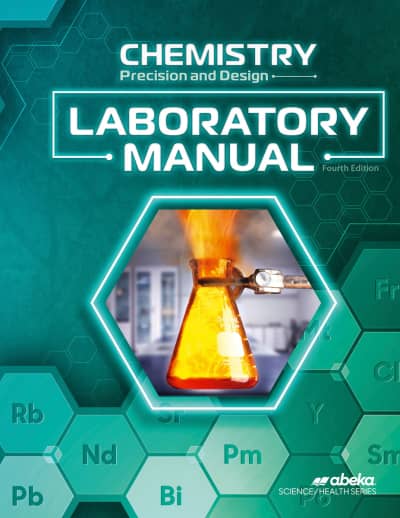
Abeka Chemistry: Precision and Design Laboratory Manual (4th Edition)
SKU
028800
Grade 11
These icons are designed to help you quickly understand and learn important information about our products.
Teaching Method
Traditional
Teacher-centered curriculum commonly used in classrooms that may include a text, teacher manual, tests, etc.
Charlotte Mason
A methodology based on the work of a 19th century educator who maintained that children learn best from literature (Living Books), not textbooks.
Classical
A methodology based on the Latin Trivium (three stages of learning), including the grammar stage (memorization and facts), logic stage (critical thinking), and rhetoric stage (developing/defending ideas).
Unit Study
A thematic or topical approach centered around one topic that integrates multiple subject areas.
Montessori (Discovery)
A methodology based on the work of a 20th century educator that emphasizes student and sensory-driven discovery learning and real-life applications.
Other
Other methodologies
Religious Content
Secular
Contains content contrary to common Christian beliefs (i.e. evolution).
Neutral
Avoids religious or theoretical topics or presents multiple viewpoints without preference.
Christian/Religious
Faith-based or including instructional religious content.
Learning Modality
Auditory
Learns through listening, talking out loud or reading out loud.
Visual
Learns through seeing, prefers written instructions and visual materials.
Kinesthetic/Tactile (Hands-On)
Learns through moving, doing and touching.
Multi-Sensory
Curriculum that employ a variety of activities/components.
Presentation
Sequential
Curriculum progresses through well-defined learning objectives. Emphasizes mastery before moving to the next topic.
Spiral
Topics and concepts are repeated from level to level, adding more depth at each pass and connecting with review.
Conceptual/Topical
Focus is on the “why,” often with a unifying concept as well as specific skills; coverage may be broader.
Teacher Involvement
Low Teacher Involvement
Student-led materials; parent acts as a facilitator.
Medium Teacher Involvement
A mix of teacher-led time and independent student work.
High Teacher Involvement
Teacher-led lessons; may utilize discussions, hands-on activities and working together.
Additional Materials Required
No other materials needed
Everything you need is included.
Other Materials Required
There are additional required resources that are a separate purchase.
Other Materials Optional
There are additional resources mentioned or recommended but are not absolutely necessary.
The revised,
4th edition Chemistry Precision and Design Lab Manual provides 27
experiments and begins with a focus on laboratory regulations and safety.
Emergency procedures are also covered, and it is recommended you review them
periodically. Each experiment offers an overview, equipment and supply lists,
step-by-step instructions and a report sheet. You will need to provide numerous
items including a lab coat/apron, safety glasses/goggles, beakers, flasks,
graduated cylinders, test tubes, Celsius thermometer, and numerous specialty
chemicals. Please contact Rainbow Resource for a full listing. Consumable. Each
student will need their own copy. Alternatively, homeschool families may be
able to incorporate a high school level chemistry kit like MicroChem Kit. While not intentionally aligned with the 4th edition Abeka
Chemistry, with a little effort, parents can line up the experiments with the
more classroom focused Abeka lab activities.
Publisher's Description of Abeka Chemistry: Precision and Design Laboratory Manual (4th Edition)
Labs provide hands-on application of text material and teach fundamental lab procedures such as safety, calorimetry, titration, and pH measurement. Includes 27 student-performed labs and 10 optional labs correlated with the text.
Presenting
the fundamental principles of chemistry, this course teaches current scientific
understanding through the lens of God's creation, with a focus on the practical
application of chemistry. Environmental issues are covered from a balanced,
conservative approach. Numerous illustrations, photographs, and diagrams help
students understand the textual information. With its comprehensive coverage of
topics including biochemistry, this course will prepare students for college
level Chemistry courses. Algebra 1 is a prerequisite. The revised 4th
edition has had numerous updates in content and layout. It is not compatible
with the previous editions.
Course
components include the Textbook, 2 Volume Teacher Edition, 2 Volume Test Book
and Test Key, the Lab Manual and Lab Manual Answer Key. These are sold
separately or in two convenient sets: Homeschool Parent Kit and the Homeschool
Student Kit. Both kits are necessary to have all the resources. Please note,
some of the lab supplies and equipment may be difficult to obtain for home use.