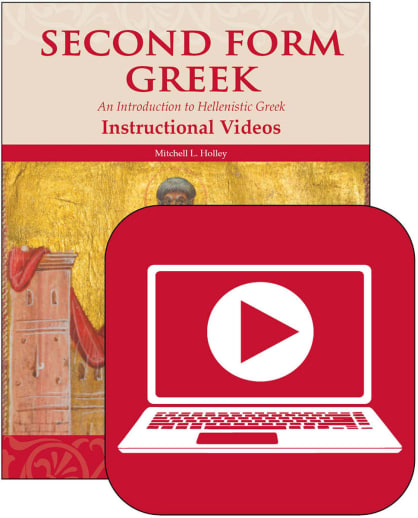
The Second Form Greek Instructional Videos by Memoria Press come in a digital streaming access. These videos are taught by Dr. Daniel Stevens—Assistant Professor of New Testament Interpretation at Boyce College. Videos include on-screen notes and information, lesson illustrations, diagrams, charts, recitations, oral drill exercises, and a lecture on each lesson. The Streaming includes Lifetime Access and 18 hours of instructional content covering all 30 lessons. Within 1-2 business days after purchase, you will receive an email from info@rainbowresource.com with instructions on how to access your digital content. Streaming videos can be accessed via computer, tablet, phone, or app. ~Rebecca
Memoria Press Second Form Greek Instructional Video Streaming
SKU
027897
Grade 8-AD
These icons are designed to help you quickly understand and learn important information about our products.
Teaching Method
Traditional
Teacher-centered curriculum commonly used in classrooms that may include a text, teacher manual, tests, etc.
Charlotte Mason
A methodology based on the work of a 19th century educator who maintained that children learn best from literature (Living Books), not textbooks.
Classical
A methodology based on the Latin Trivium (three stages of learning), including the grammar stage (memorization and facts), logic stage (critical thinking), and rhetoric stage (developing/defending ideas).
Unit Study
A thematic or topical approach centered around one topic that integrates multiple subject areas.
Montessori (Discovery)
A methodology based on the work of a 20th century educator that emphasizes student and sensory-driven discovery learning and real-life applications.
Other
Other methodologies
Religious Content
Secular
Contains content contrary to common Christian beliefs (i.e. evolution).
Neutral
Avoids religious or theoretical topics or presents multiple viewpoints without preference.
Christian/Religious
Faith-based or including instructional religious content.
Learning Modality
Auditory
Learns through listening, talking out loud or reading out loud.
Visual
Learns through seeing, prefers written instructions and visual materials.
Kinesthetic/Tactile (Hands-On)
Learns through moving, doing and touching.
Multi-Sensory
Curriculum that employ a variety of activities/components.
Presentation
Sequential
Curriculum progresses through well-defined learning objectives. Emphasizes mastery before moving to the next topic.
Spiral
Topics and concepts are repeated from level to level, adding more depth at each pass and connecting with review.
Conceptual/Topical
Focus is on the “why,” often with a unifying concept as well as specific skills; coverage may be broader.
Teacher Involvement
Low Teacher Involvement
Student-led materials; parent acts as a facilitator.
Medium Teacher Involvement
A mix of teacher-led time and independent student work.
High Teacher Involvement
Teacher-led lessons; may utilize discussions, hands-on activities and working together.
Additional Materials Required
No other materials needed
Everything you need is included.
Other Materials Required
There are additional required resources that are a separate purchase.
Other Materials Optional
There are additional resources mentioned or recommended but are not absolutely necessary.
Consumable
Consumable
Designed to be written in; not reusable.
Non-Consumable
Not designed to be written in; reusable.
Our Price
$55.00 Downloadable Product
Product Overview
- Bring the experienced teacher to your student!
- Each of the 74 videos is 10-25 minutes
- Makes a wonderful and recommended additional teaching tool for students’ studies!
Description
Publisher's Description of Memoria Press Second Form Greek Instructional Video Streaming
The Second Form Greek Streaming Instructional Videos guide students step-by-step through five logical units. These videos feature Dr. Daniel Stevens—Assistant Professor of New Testament Interpretation at Boyce College—as your instructor.
Category Description for Second Form Greek
Memoria Press’ Second Form Greek course extends and expands on the Ancient Greek language continuing from the First Form studies. Everything we love from the First Form and the Latin Series in equipping parents and teachers with or without Greek experience is included in this course. This program is designed to promote mastery and to minimize frustrating learning experiences. Picking up where First Form Greek left off, students will end this course have mastered the following:
- All third declension nouns and adjectives
- The middle and passive paradigms for all six Greek verb tenses
- The future and imperfect tenses of the to be verb
- The interrogative, indefinite, relative, and reflexive pronouns
- Over 200 vocabulary words
Students will spend approximately 30-40 minutes per lesson, 5 days a week, and parents are equipped to be as involved as they desire in the course. There is an Errata Sheet provided for this course, updated by Memoria Press. ~Rebecca
Details
| Product Format: | Other |
|---|---|
| Grades: | 8-AD |
| Brand: | Memoria Press |
| EAN/UPC: | 937-V |
Videos
Reviews