
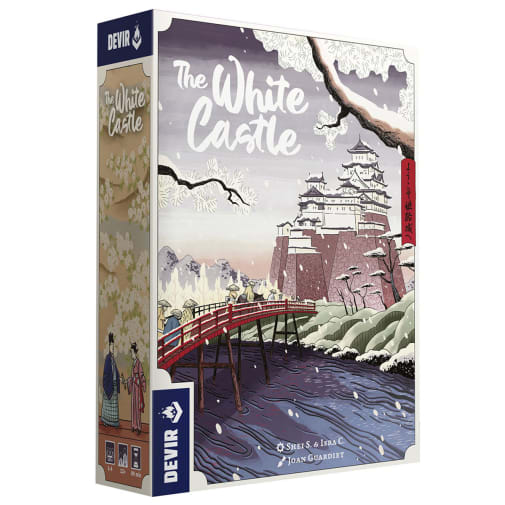
White Castle Game

SKU
026784
Grade 7-AD
Teaching Method
Traditional
Teacher-centered curriculum commonly used in classrooms that may include a text, teacher manual, tests, etc.
Charlotte Mason
A methodology based on the work of a 19th century educator who maintained that children learn best from literature (Living Books), not textbooks.
Classical
A methodology based on the Latin Trivium (three stages of learning), including the grammar stage (memorization and facts), logic stage (critical thinking), and rhetoric stage (developing/defending ideas).
Unit Study
A thematic or topical approach centered around one topic that integrates multiple subject areas.
Montessori (Discovery)
A methodology based on the work of a 20th century educator that emphasizes student and sensory-driven discovery learning and real-life applications.
Other
Other methodologies
Religious Content
Secular
Contains content contrary to common Christian beliefs (i.e. evolution).
Neutral
Avoids religious or theoretical topics or presents multiple viewpoints without preference.
Christian/Religious
Faith-based or including instructional religious content.
Learning Modality
Auditory
Learns through listening, talking out loud or reading out loud.
Visual
Learns through seeing, prefers written instructions and visual materials.
Kinesthetic/Tactile (Hands-On)
Learns through moving, doing and touching.
Multi-Sensory
Curriculum that employ a variety of activities/components.
Presentation
Sequential
Curriculum progresses through well-defined learning objectives. Emphasizes mastery before moving to the next topic.
Spiral
Topics and concepts are repeated from level to level, adding more depth at each pass and connecting with review.
Conceptual/Topical
Focus is on the “why,” often with a unifying concept as well as specific skills; coverage may be broader.
Teacher Involvement
Low Teacher Involvement
Student-led materials; parent acts as a facilitator.
Medium Teacher Involvement
A mix of teacher-led time and independent student work.
High Teacher Involvement
Teacher-led lessons; may utilize discussions, hands-on activities and working together.
Additional Materials Required
No other materials needed
Everything you need is included.
Other Materials Required
There are additional required resources that are a separate purchase.
Other Materials Optional
There are additional resources mentioned or recommended but are not absolutely necessary.
Consumable
Consumable
Designed to be written in; not reusable.
Non-Consumable
Not designed to be written in; reusable.
Our Price
$39.99 $39.99 $32.99
Rainbow Savings: $7.00

Description

It is the year 1781 in Harima province, Japan.  The looming Himeji Castle is a reminder that to have a successful future, you must use timing, management and strategy to maneuver your clan into position to obtain and keep a good standing in the province.  You can achieve this mission, if you know how to play a good game of The White Castle.

This worker placement, card-drafting and dice placement game for 1-4 players takes place over three rounds consisting of three turns each. There are three bridges in the gardens containing dice that players roll each round.  The results provide options for placement directly on the main board or on personal boards from which players can dispatch workers.

The goal in this game is to chain as many events during one turn to touch as many scoring areas and options as possible.  At the end of the game, the player with the most points wins.  Workers generate most of the points in this game and each worker placement area and type require different numbers and types of resources.  There are three types of workers:

  1.  Courtiers – These workers enter the Castle, which consists of three levels.  Each level provides increasing numbers of points per worker at game end.  They also provide cards, which players collect and place on their boards to provide resources. 
  2. Warriors – Dispatch them to the training areas to gain resources and actions.  Points are awarded per warrior depending on the area level they are placed in.  
  3. Gardeners – Send these workers out and place them on resource cards that provide resources, actions and game-end points.

Besides placing workers, there are areas inside and outside the castle that provide dice placement rewards.  These are resources, coins and game action opportunities.  If you enjoy complex game experiences with variety and competitive strategy, this game provides a challenging 80-minute playtime. ~ Marsha

Publisher's Description of White Castle Game

The heron flies over the Himeji sky while the Daimio, from the top of the castle, watches his servants move. Gardeners tend the pond where the koi carp live, warriors stand guard on the walls, and courtiers crowd the gates, pining for an audience that brings them closer to the innermost circles of the court. When night falls, the lanterns are lit and the workers return to their clan.

In The White Castle, players control one of these clans and want to score more points than the rest. To do so, they must amass influence in the court, manage resources boldly, and place their workers in the right place at the right time. All of the action takes place in the most imposing fortress in modern Japan: Himeji Castle, where the banner of the Sakai clan flies under the orders of Daimio Sakai Tadakiyo.

The White Castle is a Eurogame in which players use resource management, worker placement, and dice placement to carry out actions. During the game, over three rounds players send members of their clan to tend the gardens, defend the castle, or progress up the social ladder of the nobility. At the end of the match, these activities award players points in a variety of ways.

The central panel shows Himeji Castle in all its splendor, divided into several zones. The largest is inside the castle, with the Room of the Thousand Carpets, where the courtiers must ascend socially until they reach the circle closest to the Daimio to enjoy his favor. There is also the pond and the gardens, patiently tended by the gardeners where everyone can relax and contemplate its beauty without restriction. Another important area is the wall and the outside of the castle, where the warriors patrol and stand guard. Finally, we find the area of the three bridges, where the three types of dice that can be used to carry out actions are accumulated, and the personal domain of each player, where they will keep track of their resources and where they will have a reserve of workers.

Category Description for White Castle Game

Each of these books holds 50 fun dot-to-dot puzzles that improve skills in number recognition, hand-eye coordination, drawing, word skills, and more. Connecting all the dots makes a picture of an animal or other kid-friendly object and completing these pictures builds self-esteem. Puzzles get more advanced through the individual books (from connecting numbers 1-11 to 1-39), but each book is geared toward the same grade and has the same difficulty level overall. Pages are in black and white, reproducible, and include solutions. The finished puzzles are also fun to color. 64 pgs, pb. - Jon

Details
More Information
Product Format:Other
Grades:7-AD
Brand:Devir Games
EAN/UPC:8436607940593
Length in Inches:9.0625
Width in Inches:7.125
Height in Inches:2.625
Weight in Pounds:2.9
Videos
This product doesn't have a video
Reviews
Product Q&A