
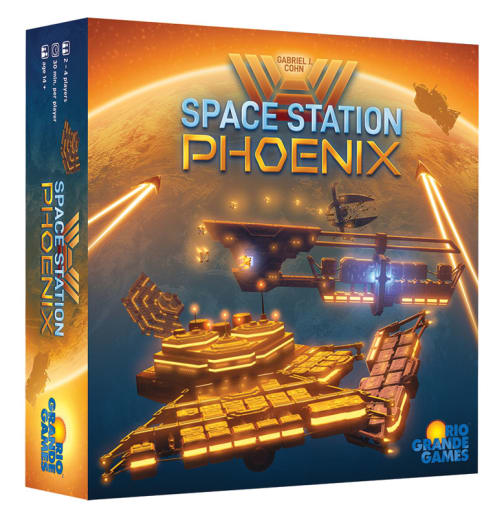
A new solar system has been discovered near Earth! This is an exciting opportunity for you and your fellow astronauts to see who can build the largest space station and house the most aliens, who bring fresh information and ideas. It will also be important to accommodate humans to work alongside you and the aliens to truly make this a cooperative experience. So begins the game of Space Station Phoenix, where diplomacy, careful strategic planning, and resource management might earn you enough victory points to win!
Here is a summary of the components and actions in the game:
Player Board: Everyone starts with the board, tokens, and markers in their color. The boards are all the same and provide a basic guide to the actions in the game.
Currency: Gems (Galactic Exchange Minerals) in denominations of one, five, and twenty are used to pay costs to take actions in this game and move up on the diplomacy board.
Resources: There are three resources to help build your space station and populate it. Food and water are needed to add aliens to your population, metal is added to food and water to attract human populations, and metal is also used to add segments to your spaceship. Segments provide spaces for humans and aliens to reside, as well as extra resources, points, currency, and sometimes extra bonus actions.
Diplomacy Board: This is the main shared board and its purpose is twofold. Players use it to track their victory points during the game and at game-end. There are also four diplomacy tracks that represent the dismantle, construct, transport, and expedition actions. Each time a ship card action is used during a player’s turn, all players whose markers are on the corresponding track gain benefits based on their actual and relative positions on this track. To move up this track, players can take the diplomacy action on their turn.
Player Hub: All spaceships start with a center hub. The game comes with 12 basic and 12 advanced hubs, which are all different. Each player receives two random hubs and chooses one. The back of each hub provides starting resources, gems, and other additional components that are unique to that hub. For example, some players may gain an extra ship, start with more gems, or move up a level on one of the diplomacy tracks to start. Once a player has gained their beginning resources, the hub is flipped over and placed at the top of their player board, and it becomes the center of their future space station. The face of the hub may provide unique game-end points or additional resources when a player takes a specific action.
Space Station Sectors: There are three different colors and sizes of sectors, which are level one (small), level two (medium), and level three (large). Starting with the smallest size sectors, players build them out from the hub as wings of the same color. Each wing will become home to either an alien of its matching color (pink, blue, or brown), gold aliens, or humans. Besides earning game-end points, these sectors provide in-game bonuses and abilities when populated with aliens or humans.
Aliens and Humans: Aliens and humans populate players’ spaceships and, depending on the sectors on their ships, adding them helps provide extra resources and points when taking an action or during a turn to collect income. The main way to gain aliens is by using the transport ship action, which allows players to roll dice that can provide water, food, metal, and aliens. Humans are most often gained with the Terran expedition ship action, when a player rolls dice to gain water, food, metal, and humans. When a human is rolled, the player may trade food, water, and metal to place a human on their ship.
Actions: At the beginning of the game, players have a starting set of five identical spaceship cards that provide action choices. They will also draft an additional four cards for a total of nine (there may be ship hubs that grant additional cards as their starting resources). There are seven different types of ship cards that players use to take action on their turns. These cards can provide resources, populate space stations, construct ships, dismantle ships to gain metal resources, and gain diplomacy.
End Game and Game Points: The game end is triggered when the active player reaches 40 game points or has built all nine sectors of their spaceship or when there are four or less aliens remaining in the supply. After everyone else gets one more turn, game-end scoring (which rewards built spaceship sectors and their populations) takes place and the person with the most points wins!
Who is this game’s main audience? 1) People who like space-themed games, 2) Fans of medium-heavy games with a 1–2-hour playtime, and 3) Fans of worker-placement games where players and components have variable rewards, resources, and bonuses. I enjoyed this game even though the space theme is not my usual choice. For 2-4 players with 3 players being the optimal experience, in my opinion. This game usually takes 60-90 minutes to play. – Marsha