
Beginning with an introduction to atoms and how they work, students learn about electricity, electrical currents and wires, batteries, magnets and power stations, how electricity gets into our homes, home circuits, as well as outlets and plugs. It also includes an overview of everyday electricity applications including hydroelectric power, as well as wind and solar power. Additional required materials include alligator clip leads (6), 6-volt lantern batteries (2), 6-volt miniature light bulbs (2), bulb holders, 12-volt motors, single blade knife switch, electrical wire, circuit breaker, uninsulated and insulated 18 g. copper wire, LED bulb, galvanized nails (5), galvanometer, magnet, three-inch-long bolt, 120-volt transformer, simple voltmeter, small motor, hand0crank generator, and other household items. A complete list is in the Teacher Resources material.
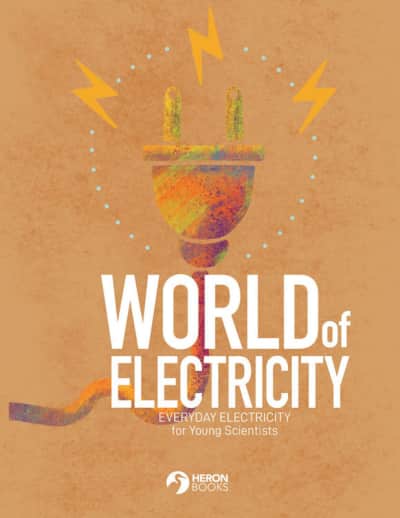
World of Electricity - Everyday Electricity for Young Scientists
Description
Beginning with atoms and electrons, and positive and negative charges, this amply-illustrated book explains, simply and clearly, what electricity is and how it is generated and distributed through the power grid to businesses and homes. It covers circuits, circuits boxes, short circuits, switches and plugs as used in homes, and touches on alternate sources of electricity such as hydroelectric, wind and solar. A number of interesting experiments and projects are included in the book.
The book's associated learning guide walks the student through the book, its experiments and several additional activities, including work in a science journal where the student is encouraged to keep track of their own thoughts and observations. By the end a student will know what electricity is, where it comes from and how to work with it.
| Product Format: | Other |
|---|---|
| Grades: | 4-6 |
| Brand: | Heron Books |
| ISBN: | 9780897392969 |
| Length in Inches: | 11.5 |
| Width in Inches: | 9 |
| Height in Inches: | 0.375 |
| Weight in Pounds: | 0.95 |