
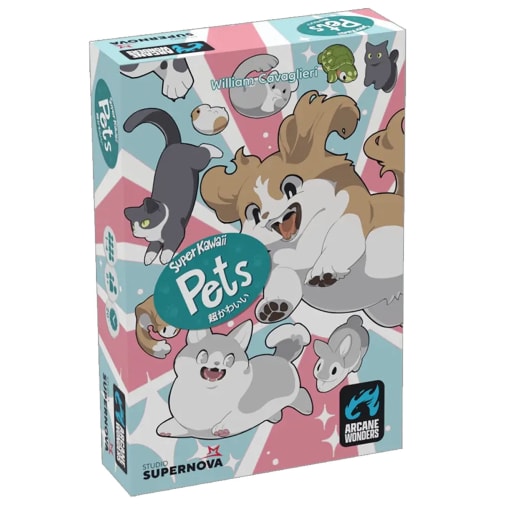
When you want a cute card game to play with family or a
light game to fill some time with friends, Super Kawaii Pets from
Arcane Wonders might be the cutest, coziest card game around. What is more
heartwarming than trying to heal sad animals, watching their tears stop flowing,
and helping dogs, cats, rabbits, and other assorted creatures to smile again?
Afterwards, you can give them a home in a warm bed, chair, or cozy crate. Best
of all, by completing these actions, you can earn the most points and win the
game! Let’s move on to gameplay before
this gets too sappy.….
There are three types of cards in this game with unique functions and rewards.
- Animal cards: Shuffle these and place them in a stack with the sad animal side up. Put the top two cards in a row to the right of the deck and leave the top card in the deck face-up. Each animal card has information in its upper right-hand corner that shows which healing cards they need to make them happy. Some cards have a colored card symbol on their upper left side that gives the player the right to draw a displayed animal or helper card that matches the color, help symbol, or animal type when the card is played. The other information shown on the card includes the victory points you score if that animal is played and happy at the end of the game and whether the animal belongs to the dog, cat, or rodent species—or is “wild” and may belong to any species for the purpose of matching a location (explained below).
- Helper cards: These people provide one of three different types of care: love, physical healing, and food. Shuffle them and place them in a facedown stack below the Animal cards. Put the top three cards face up in a row to the right of the deck.
- Location cards: These cards provide a place for happy animals to stay. Put this deck facedown to the right of the other cards and put three of them face up to the left of the deck. Each card shows which happy animals are required to obtain it and provide game-end points. Some location cards have the same card symbols on their upper left as the animal cards, which provide the right to draw a displayed animal or helper card that matches the color, help symbol, or animal type when the location card is played.
Choose someone to go first and the game begins! On a player’s turn, they will do the following:
Draw two cards from the Animal and Helper card displays or deck.
- Next, players may perform any of the following 3 actions in any order and as many times as they want and are able. 1) Choose an animal card from their hand to play with its sad side face up. 2) Once played, if they have the required love, healing, or food for an animal they have played, they can discard the required healing cards and flip the animal card to its happy side. A player may also discard any 2 symbols of help cards to substitute for one of the required symbols. 3) Location cards show required happy animals to play them. When one of the displayed location cards matches happy animals that are not already assigned to a location, a player may grab it and place the happy animal cards underneath it. Once there, they cannot be relocated during the game.
- When a player completes their turn, they must discard down to a hand size of 5 cards. The next player replaces any empty spaces where cards were taken during the previous player's turn and starts their turn. The game end triggers when a player reaches a total of 10 played cards between happy Animals and Location cards and ends once all players have had the same number of turns.
Scoring: Add up victory points from happy Animals and Location cards. Lose 1 point for each sad Animal left in front of you or in your hand. The player with the most points wins!
This family-friendly game has so many great things going for it in my opinion. With its small box, it is portable and easy to bring along on trips. The rulebook is compact, easy to comprehend, and well-illustrated. The cards are adorable, and the game is fast and fun! For 1-4 players with 20-minute game time. Solo rules are included. ~ Marsha