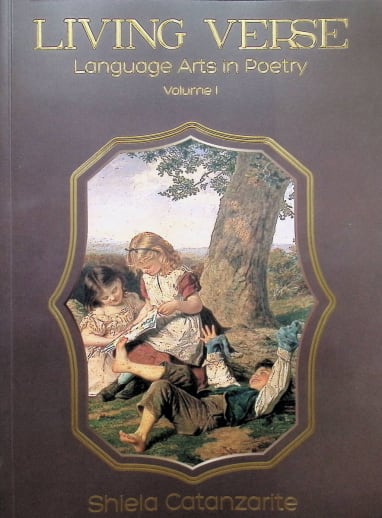
Poetry is everywhere—in songs and
hymns, advertisements, children’s books, and in Scripture—and, therefore, it’s a
wonderful genre to study. I’ve also found that poetry’s conciseness, as well as
its alluring lyrical qualities make it a perfect genre to help students
strengthen multiple language arts skills while not feeling overwhelmed. This 28-week
language arts curriculum engages multiple ages at 4 lessons per week. You and
your children are guided to study one poet each month, beginning and ending with
an author focus (including a short biography). Throughout the month, follow a
pattern of 7 additional goals: experience (reading, illustrating or writing what
the poem elucidates), mark, discover, interpret, copy, express, and model the
poem.
Over the school year, students will
engage with writings from Mary Howitt Botham; Henry Wadsworth Longfellow;
Edward Lear; Eleanor Farjeon; Isaac Watts; Rachel Field; and William Blake. Charlotte
Mason approaches are used repeatedly throughout: children will respond to the
literature selections by drawing, narrating and rephrasing, illustrating, and
writing copywork. They will learn how to read aloud, interpret and reflect on
the poem, imitate the author’s style, and write their own poems based on their
imagination. While engaging with the poetry, students will learn to mark lines,
stanzas, rhyme schemes, identifying new-to-them words, learn about points of
view, mood, parts of speech, interpreting meaning, and rhythm. Periodically,
students may celebrate the author’s work with a poetry tea time—what a fabulous
idea! The publisher calls this a gentle approach to language arts. However,
this course does not include reading instruction and you’ll want to add full
texts from varied types of literature. Answers in back. Nonreproducible, 200
pgs, pb. Scriptures taken from the NKJV, ©1982.