
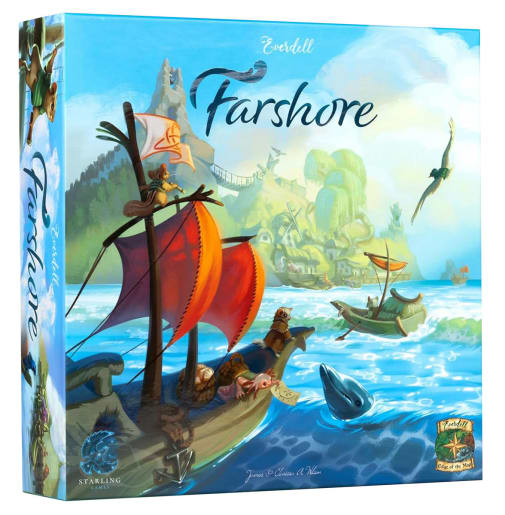
In Everdell, legend has it that there are abundant
resources, treasures, and best of all, breathtaking beauty on the north coast
of the valley. Although the land is mostly uninhabited, a group of Everdell’s
beavers, puffins, ducks, and crabs set out to build and inhabit this land
called Farshore in search of new adventures.
Once in Farshore, this adventuring band of seafaring critters
found that driftwood, seaweed, seastones, and mushrooms were plentiful
resources that could be used to construct their lighthouses, gardens, markets,
and many other common and unique structures. Soon, new critter friends like the
sculptor, sea chip, and sail maker appeared to provide services to the
burgeoning community. Let’s join them to explore, learn, gather, and enjoy
everything Farshore has to offer!
Whether you have experienced the original Everdell game or
not, this stand-alone version is more than worthy of your time and play. There are similarities in gameplay between the two, but the differences are ones that I find streamline the game in ways that are complementary and unique. This game still involves enough strategy to create challenges but provides a smoother, cohesive learning and play experience.
In short, both games have a place in my game library.
Everdell: Farshore begins during the winter season with two critter
workers available to all players. Critters visit various resource locations on
the board to gather items needed to play cards. There are three more seasons
for each player to initiate independently when they have no further workers
they can send out or cards they can play. Once spring, summer, and fall seasons
have elapsed for each player, the game ends, and the person with the most
points wins!
Points: There are six unique ways to gain points in this game:
- Values listed on all played cards
- Bonus points from Purple “prosperity” cards
- Point tokens accumulated (shells)
- Treasure Tiles
- Points from position of your ship at the end of the game
- Map Tile bonuses
Cards: The core of this game is the main deck cards (Construction and Critter). Each person may place 15 cards in their play “tableau” area. These cards have costs consisting of different combinations of the resources mentioned above. Cards provide immediate awards, their own worker placement offerings, and ongoing actions during the game and at the start of spring and fall seasons. Finally, there are cards that provide end-game bonuses that reward specific combinations of cards that inhabit your play area.
Point Tokens: Some cards – like the Scribe Critter – provide opportunities to collect shells. Each one is worth one point at the end of the game.
Ship Position Points and Treasure Tiles: There is a ship track encircling the lower part of the board. Each player starts with their own ship token that can move along this track to gain game-end points. Ship movement is driven by card play in two unique ways. 1) Windrose tiles are placed in two stacks at the beginning of the game. Stack A consists of both construction and critter designated tiles. Stack B consists of different card colors/functions. Each season, the Windrose stacks are refreshed with different choices. When a card is played to a tableau, if it matches either or both active Windrose tiles, the player moves their ship one space for each match. 2) There are some card activations that let players advance their ships.
As players move their ships, they may land on or pass
treasure icons. Each time they do, a treasure tile is collected, which can be
used in one of two ways: 1) Trade a tile for one of any resource. 2) Collect them
for two points each at game-end.
Map Tiles: At the “Dunes” resource location, players may obtain a map tile by matching its required quantity of any of the five card types they have played to their tableau or one of each of all types of cards. These tiles can provide valuable end-game points.
With this not-so-brief description, which is not as complete
as the succinct, well-done rulebook, I hope to help inform your decision on
whether this might be a game for you. This 1-4 player game is a delightful
40–80-minute visit to an experience that resonates with me, and I highly
recommend it! ~Marsha