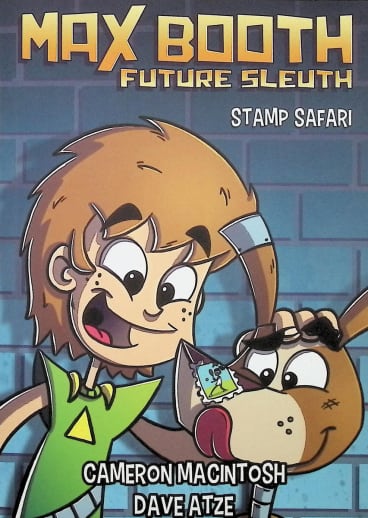
Max, Jessie, and Oscar have to discover the story behind the ancient, sticky piece of paper they found. In their quest to figure it out, they have to avoid being captured, reconnect with an old friend, and rescue their beagle-bot Oscar from the Behavior Readjustment Laboratory! 130 pgs, pb.
Max Booth, Future Sleuth: Stamp Safari
SKU
019978
ISBN
9781538384688
Grade 3-5
These icons are designed to help you quickly understand and learn important information about our products.
Teaching Method
Traditional
Teacher-centered curriculum commonly used in classrooms that may include a text, teacher manual, tests, etc.
Charlotte Mason
A methodology based on the work of a 19th century educator who maintained that children learn best from literature (Living Books), not textbooks.
Classical
A methodology based on the Latin Trivium (three stages of learning), including the grammar stage (memorization and facts), logic stage (critical thinking), and rhetoric stage (developing/defending ideas).
Unit Study
A thematic or topical approach centered around one topic that integrates multiple subject areas.
Montessori (Discovery)
A methodology based on the work of a 20th century educator that emphasizes student and sensory-driven discovery learning and real-life applications.
Other
Other methodologies
Religious Content
Secular
Contains content contrary to common Christian beliefs (i.e. evolution).
Neutral
Avoids religious or theoretical topics or presents multiple viewpoints without preference.
Christian/Religious
Faith-based or including instructional religious content.
Learning Modality
Auditory
Learns through listening, talking out loud or reading out loud.
Visual
Learns through seeing, prefers written instructions and visual materials.
Kinesthetic/Tactile (Hands-On)
Learns through moving, doing and touching.
Multi-Sensory
Curriculum that employ a variety of activities/components.
Presentation
Sequential
Curriculum progresses through well-defined learning objectives. Emphasizes mastery before moving to the next topic.
Spiral
Topics and concepts are repeated from level to level, adding more depth at each pass and connecting with review.
Conceptual/Topical
Focus is on the “why,” often with a unifying concept as well as specific skills; coverage may be broader.
Teacher Involvement
Low Teacher Involvement
Student-led materials; parent acts as a facilitator.
Medium Teacher Involvement
A mix of teacher-led time and independent student work.
High Teacher Involvement
Teacher-led lessons; may utilize discussions, hands-on activities and working together.
Additional Materials Required
No other materials needed
Everything you need is included.
Other Materials Required
There are additional required resources that are a separate purchase.
Other Materials Optional
There are additional resources mentioned or recommended but are not absolutely necessary.
Consumable
Consumable
Designed to be written in; not reusable.
Non-Consumable
Not designed to be written in; reusable.
Our Price
$16.45 $16.45 $12.50
Rainbow Savings: $3.95
Product Overview
- Futuristic, high-tech, fast-paced novels for young readers
- Large font, wide-spaced lines, and blackline illustrations
- Includes fun facts about the postage stamps in the “Sleuth Truth” section
Description
Publisher's Description of Max Booth, Future Sleuth: Stamp Safari
A tiny piece of paper from the year 2019 might not sound very
interesting to most people. But Max and Oscar, who are Bluggsville's
sharpest sleuths, aren't most people! Max has a hunch that this ancient
patch of paper might be valuable and extremely rare. Max is right. This
isn't just any old piece of paper. It's a strange, sticky thing called a
postage stamp, and it's more than 400 years old! It's an exciting
discovery, but before long, it leads Max and Oscar into some very sticky
situations...
Category Description for Max Booth, Future Sleuth Series
This futuristic novel series set in 2424 follows Max Booth, his best friend Jessie, and his sidekick robo-dog Oscar as they investigate relics from hundreds of years earlier. With humorous references to the 20th century, the young sleuths from Bluggsville try to solve mysteries, investigate “ancient” technologies, and avoid danger along the way! At the end of each book, there is a “Sleuth Truth” that gives the facts about the technology mentioned in the novel. If you have a child who loves high-tech or futuristic stories, these short novels will capture their imagination and have them asking for the next book in the series! Wide-spaced lines, large fonts and occasional black-line illustrations are perfect for the younger student who is starting to read novels. ~Tara
Details
| Product Format: | Paperback Book |
|---|---|
| Grades: | 3-5 |
| Brand: | West 44 Books |
| Author: | Cameron Macintosh |
| ISBN: | 9781538384688 |
| Length in Inches: | 8.25 |
| Width in Inches: | 5.875 |
| Height in Inches: | 0.3125 |
| Weight in Pounds: | 0.55 |
Videos
Reviews