
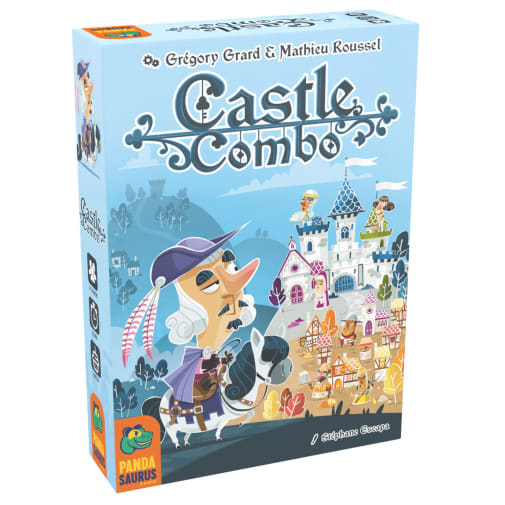
Castle Combo Game

SKU
018651
Grade 5-AD
Teaching Method
Traditional
Teacher-centered curriculum commonly used in classrooms that may include a text, teacher manual, tests, etc.
Charlotte Mason
A methodology based on the work of a 19th century educator who maintained that children learn best from literature (Living Books), not textbooks.
Classical
A methodology based on the Latin Trivium (three stages of learning), including the grammar stage (memorization and facts), logic stage (critical thinking), and rhetoric stage (developing/defending ideas).
Unit Study
A thematic or topical approach centered around one topic that integrates multiple subject areas.
Montessori (Discovery)
A methodology based on the work of a 20th century educator that emphasizes student and sensory-driven discovery learning and real-life applications.
Other
Other methodologies
Religious Content
Secular
Contains content contrary to common Christian beliefs (i.e. evolution).
Neutral
Avoids religious or theoretical topics or presents multiple viewpoints without preference.
Christian/Religious
Faith-based or including instructional religious content.
Learning Modality
Auditory
Learns through listening, talking out loud or reading out loud.
Visual
Learns through seeing, prefers written instructions and visual materials.
Kinesthetic/Tactile (Hands-On)
Learns through moving, doing and touching.
Multi-Sensory
Curriculum that employ a variety of activities/components.
Presentation
Sequential
Curriculum progresses through well-defined learning objectives. Emphasizes mastery before moving to the next topic.
Spiral
Topics and concepts are repeated from level to level, adding more depth at each pass and connecting with review.
Conceptual/Topical
Focus is on the “why,” often with a unifying concept as well as specific skills; coverage may be broader.
Teacher Involvement
Low Teacher Involvement
Student-led materials; parent acts as a facilitator.
Medium Teacher Involvement
A mix of teacher-led time and independent student work.
High Teacher Involvement
Teacher-led lessons; may utilize discussions, hands-on activities and working together.
Additional Materials Required
No other materials needed
Everything you need is included.
Other Materials Required
There are additional required resources that are a separate purchase.
Other Materials Optional
There are additional resources mentioned or recommended but are not absolutely necessary.
Consumable
Consumable
Designed to be written in; not reusable.
Non-Consumable
Not designed to be written in; reusable.
Our Price
$29.95 $29.95 $23.95
Rainbow Savings: $6.00

Description

Whether you wander the village or enter the castle, the cast of 78 character cards holds the coins, keys, goals, and victory points that players compete for in this clever "combotastic" card placement challenge! There are only nine player turns each in Castle Combo, perfectly balancing luck and strategy in the card choices everyone makes as they build 3x3 grids that grant both immediate benefits and end-game points. Once everyone’s nine-card tableau is built, each card is scored. Accumulated castle keys are also worth one point each. The player with the most points total wins! 

A detailed look into Castle Combo: Components are simple, consisting of 39 castle cards, 39 village cards, 52 gold coins, 44 key tokens, one messenger token, a score pad, and 1 double-sided game aid, which summarizes the icons used in the game. There are two types of cards, which are grey Castle Cards and brown Village Cards. At the top of all cards, it shows the cost in coins to play the card, as well as one or two shields of six different colors, which can be used to score placement points or gain rewards. Each player starts with 15 coins and 2 keys. Additional keys can be obtained during the game and are worth one point each at the end of the game. Other uses for keys are explained later in this description.

The cards are divided into two draw piles, with a display of three castle cards and three village cards to the right of each deck, with the castle row at the top. The messenger token starts at the right of the row of village cards. Its role in the game is to move between village and castle card displays during the game to designate which type of card is active for the next player’s draw choice.

For example, when a player takes one of the cards from a display and plays it onto their grid, if that card displays a down-facing arrow in the other card type’s color, the messenger moves to that row. If the next player wants to move the messenger to choose a card from the other row, they may use one key as payment to do so. A player may also use a key to discard all cards in the row where the messenger is and replace them with 3 new cards from that row’s deck.

Choosing each card and its placement on their grid carefully provides players with the opportunity to balance strategy with luck as new cards come out that may bring new scoring advantages.  Because there are both immediate rewards and game-end goals and their costs vary, careful planning can help balance things out over the course of the game. Obviously, some end-game goal cards are more advantageous than others to play early in the game, such as those with discounts on future card purchases, coin purses to stash extra coins for game-end points (as coins remaining in player’s supplies are not worth points), or scoring based on colors of adjacent card shields.

After the last player completes their 3x3 grid, each card is scored separately on the score pad using the game-end point criteria on each card, and the player with the most points wins! 

After my many plays of Castle Combo with friends and family, this game has secured a spot on my favorites list and has also become popular with board game hobbyist groups! I love that it plays in 25 minutes too! ~Marsha

Publisher's Description of Castle Combo Game

You're hereby invited to His Majesty's grand Combo Party! Recruit characters to your personal tableau, making sure to take note of the unique abilities and scoring conditions each one offers.

Players will take turns recruiting characters from 2 open markets on the table. Each character has a different ability and endgame scoring conditions. Cards must be placed in a 3x3 grid, and the position of each character may be the difference between victory and defeat!

Details
More Information
Product Format:Other
Grades:5-AD
Brand:Pandasaurus Games
EAN/UPC:850059057124
Length in Inches:7.125
Width in Inches:5.125
Height in Inches:1.875
Weight in Pounds:1.15
Videos
This product doesn't have a video
Reviews
Product Q&A