These icons are designed to help you quickly understand and learn important information about our products.
Teaching Method
Traditional
Teacher-centered curriculum commonly used in classrooms that may include a text, teacher manual, tests, etc.
Charlotte Mason
A methodology based on the work of a 19th century educator who maintained that children learn best from literature (Living Books), not textbooks.
Classical
A methodology based on the Latin Trivium (three stages of learning), including the grammar stage (memorization and facts), logic stage (critical thinking), and rhetoric stage (developing/defending ideas).
Unit Study
A thematic or topical approach centered around one topic that integrates multiple subject areas.
Montessori (Discovery)
A methodology based on the work of a 20th century educator that emphasizes student and sensory-driven discovery learning and real-life applications.
Other
Other methodologies
Religious Content
Secular
Contains content contrary to common Christian beliefs (i.e. evolution).
Neutral
Avoids religious or theoretical topics or presents multiple viewpoints without preference.
Christian/Religious
Faith-based or including instructional religious content.
Learning Modality
Auditory
Learns through listening, talking out loud or reading out loud.
Visual
Learns through seeing, prefers written instructions and visual materials.
Kinesthetic/Tactile (Hands-On)
Learns through moving, doing and touching.
Multi-Sensory
Curriculum that employ a variety of activities/components.
Presentation
Sequential
Curriculum progresses through well-defined learning objectives. Emphasizes mastery before moving to the next topic.
Spiral
Topics and concepts are repeated from level to level, adding more depth at each pass and connecting with review.
Conceptual/Topical
Focus is on the “why,” often with a unifying concept as well as specific skills; coverage may be broader.
Teacher Involvement
Low Teacher Involvement
Student-led materials; parent acts as a facilitator.
Medium Teacher Involvement
A mix of teacher-led time and independent student work.
High Teacher Involvement
Teacher-led lessons; may utilize discussions, hands-on activities and working together.
Additional Materials Required
No other materials needed
Everything you need is included.
Other Materials Required
There are additional required resources that are a separate purchase.
Other Materials Optional
There are additional resources mentioned or recommended but are not absolutely necessary.
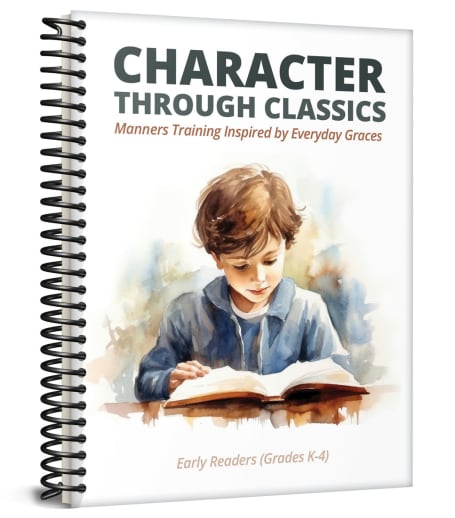
Learn manners and good character from classic poetry,
fables, and literature excerpts from books such as The Secret Garden, A
Little Princess, and Pinocchio. Stories can be read aloud by a parent or by
the student if they are reading independently.
Activities include tracing new vocabulary words, doing copywork from the
readings, and answering questions for oral narration. There are also spaces to draw scenes from the
stories. Spiral-bound softcover, 200
pgs.
Note: one excerpt from Anne of Green Gables describes
the death of a loved one which may be difficult for sensitive readers.
Publisher's Description of Character Through Classics - Early Readers (K-4)
This open-and-go curriculum helps children in Grades K-4 develop compassion, respect, and self-discipline through classic literature and engaging activities.
Featuring over 40 stories and poems, Character Through Classics features five core components:
Literary Excerpts: Introduce your child to timeless stories and poems that captivate their imagination while imparting important moral lessons.
Vocabulary: Expand your child’s vocabulary with lesser known words from each story. Includes tracing lines for copywork practice.
Narration: Encourage active listening and
comprehension as children retell stories in their own words,
reinforcing key ideas and improving retention.
Activity: Foster creativity and fine motor skills through drawing prompts and copywork that promote thoughtful reflection of the lessons.
Scripture Memorization: Connect timeless virtues to biblical truths through carefully selected verses that complement the manners and morals discussed.
Raising children who value humility, honor, and hard work
in a culture that pushes selfishness, disrespect, and apathy is no easy
task—but it is a worthy one.
Just like Jesus taught timeless principles through parables
and storytelling, this series teaches character and manners through classic
literature. Each lesson begins with a poem or literature excerpt followed by language-building
activities such as comprehension questions, Bible memory, and vocabulary work. A
9-week, 5-day suggested schedule is included, and the rest of the materials are
very open-and-go with little to no teacher preparation. Although it is easy for the student to work independently,
parental involvement in discussing the lessons will make it more impactful. The three levels all include the same excerpts
so you can learn together as a family.