
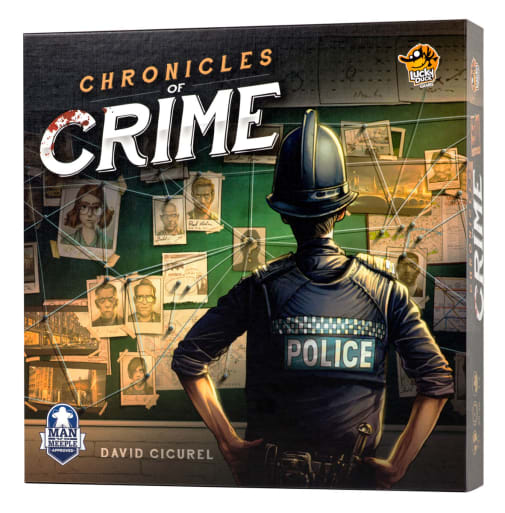
Chronicles of Crime

SKU
015515
Grade 7-AD
Teaching Method
Traditional
Teacher-centered curriculum commonly used in classrooms that may include a text, teacher manual, tests, etc.
Charlotte Mason
A methodology based on the work of a 19th century educator who maintained that children learn best from literature (Living Books), not textbooks.
Classical
A methodology based on the Latin Trivium (three stages of learning), including the grammar stage (memorization and facts), logic stage (critical thinking), and rhetoric stage (developing/defending ideas).
Unit Study
A thematic or topical approach centered around one topic that integrates multiple subject areas.
Montessori (Discovery)
A methodology based on the work of a 20th century educator that emphasizes student and sensory-driven discovery learning and real-life applications.
Other
Other methodologies
Religious Content
Secular
Contains content contrary to common Christian beliefs (i.e. evolution).
Neutral
Avoids religious or theoretical topics or presents multiple viewpoints without preference.
Christian/Religious
Faith-based or including instructional religious content.
Learning Modality
Auditory
Learns through listening, talking out loud or reading out loud.
Visual
Learns through seeing, prefers written instructions and visual materials.
Kinesthetic/Tactile (Hands-On)
Learns through moving, doing and touching.
Multi-Sensory
Curriculum that employ a variety of activities/components.
Presentation
Sequential
Curriculum progresses through well-defined learning objectives. Emphasizes mastery before moving to the next topic.
Spiral
Topics and concepts are repeated from level to level, adding more depth at each pass and connecting with review.
Conceptual/Topical
Focus is on the “why,” often with a unifying concept as well as specific skills; coverage may be broader.
Teacher Involvement
Low Teacher Involvement
Student-led materials; parent acts as a facilitator.
Medium Teacher Involvement
A mix of teacher-led time and independent student work.
High Teacher Involvement
Teacher-led lessons; may utilize discussions, hands-on activities and working together.
Additional Materials Required
No other materials needed
Everything you need is included.
Other Materials Required
There are additional required resources that are a separate purchase.
Other Materials Optional
There are additional resources mentioned or recommended but are not absolutely necessary.
Consumable
Consumable
Designed to be written in; not reusable.
Non-Consumable
Not designed to be written in; reusable.
Our Price
$60.00 $60.00 $31.95
Rainbow Savings: $28.05

Description

Report to Scotland Yard and talk to Chief Officer Doyle, who is summoning you to investigate a crime that occurred in one of 16 different locations in the city of London. Once he gives you general information about the crime, he tells you to visit the crime scene, look for clues, and gather information, which you hope to use as evidence to help solve the case. You need to find out who committed the crime by interrogating suspects, gathering evidence, determining a motive, and then returning to Scotland Yard, where you will answer questions that relate to the crime. If you are successful, you can move on to another case. If you fail or wish to gain a better score, you can replay it. This game is the first in a series of crime-solving games and contains a tutorial case as well as 12 cases/scenarios to solve. Play solo or with up to four people as a cooperative deduction experience.

When you first start, you will download the free app from either the Apple Store or Google Play.  Once downloaded, you can play on your phone or tablet without an internet connection. Included in the game is an evidence board, evidence cards, location boards, character cards, and special-items cards. Chief Officer Doyle will give you the location and type of crime for the case that you choose. Once you visit the crime scene, examine the location for clues to start you on a path to look for more clues, and submit different types of evidence you find to experts at the Morgue, Intelligence Bureau, Forensic Laboratory, or Criminology Center. Gather additional clues by questioning suspects and follow where the clues lead you. Sometimes another look at the crime scene yields additional clues and suspects. 

I really enjoyed my initial play of this game, mostly because it is so forgiving. It has a variety of cases to solve, and they can be re-played. I also see it as a useful tool to hone deduction and cooperative skills. This is the first Chronicles of Crime game, followed by the Millenium versions (Chronicles of Crime 1400, 1900, and 2400) that are also available for purchase here. For 1-4 players with 60–90 minute game time.

Publisher's Description of Chronicles of Crime
Our critically acclaimed and award-winning cooperative crime investigation game!
Category Description for Chronicles of Crime Games

Chronicles of Crime and its Millenium Series (Chronicles of Crime 1400, 1900, and 2400) form a group of cooperative or solo deduction games that use a phone or tablet app together with the board game to present different crime scenarios and give players all the tools needed to solve them. The board game aspects include Evidence Boards and Cards, Suspects, Forensic Contacts, and Crime Scene Locations that are all scannable by the app. The app provides feedback, stories and dialogues needed to follow and assemble clues from the crime scene locations, suspects, forensic contacts, and evidence for assembling a logical deduction tree to help solve the crime.  The scenarios can be played more than once if you want to obtain a better score on any of them or play them anew with a different group of people.  

Details
More Information
Product Format:Other
Grades:7-AD
Brand:Lucky Duck Games
EAN/UPC:603813959628
Length in Inches:11.6875
Width in Inches:11.625
Height in Inches:2.25
Weight in Pounds:2
Videos
This product doesn't have a video
Reviews
Product Q&A