These icons are designed to help you quickly understand and learn important information about our products.
Teaching Method
Traditional
Teacher-centered curriculum commonly used in classrooms that may include a text, teacher manual, tests, etc.
Charlotte Mason
A methodology based on the work of a 19th century educator who maintained that children learn best from literature (Living Books), not textbooks.
Classical
A methodology based on the Latin Trivium (three stages of learning), including the grammar stage (memorization and facts), logic stage (critical thinking), and rhetoric stage (developing/defending ideas).
Unit Study
A thematic or topical approach centered around one topic that integrates multiple subject areas.
Montessori (Discovery)
A methodology based on the work of a 20th century educator that emphasizes student and sensory-driven discovery learning and real-life applications.
Other
Other methodologies
Religious Content
Secular
Contains content contrary to common Christian beliefs (i.e. evolution).
Neutral
Avoids religious or theoretical topics or presents multiple viewpoints without preference.
Christian/Religious
Faith-based or including instructional religious content.
Learning Modality
Auditory
Learns through listening, talking out loud or reading out loud.
Visual
Learns through seeing, prefers written instructions and visual materials.
Kinesthetic/Tactile (Hands-On)
Learns through moving, doing and touching.
Multi-Sensory
Curriculum that employ a variety of activities/components.
Presentation
Sequential
Curriculum progresses through well-defined learning objectives. Emphasizes mastery before moving to the next topic.
Spiral
Topics and concepts are repeated from level to level, adding more depth at each pass and connecting with review.
Conceptual/Topical
Focus is on the “why,” often with a unifying concept as well as specific skills; coverage may be broader.
Teacher Involvement
Low Teacher Involvement
Student-led materials; parent acts as a facilitator.
Medium Teacher Involvement
A mix of teacher-led time and independent student work.
High Teacher Involvement
Teacher-led lessons; may utilize discussions, hands-on activities and working together.
Additional Materials Required
No other materials needed
Everything you need is included.
Other Materials Required
There are additional required resources that are a separate purchase.
Other Materials Optional
There are additional resources mentioned or recommended but are not absolutely necessary.
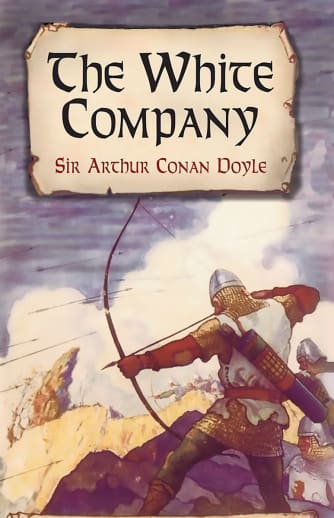
Sir Arthur Conan Doyle’s adventurous story of knights in
battle in the Middle Ages. The White Company were their archers. Read realistic
depictions of life in the 14th century told through compelling
characters!
The author (1859–1930) is a Scottish writer best known for
creating Sherlock Holmes, but he was an avid historian as well. He also
received a medical degree from the University of Edinburgh. 416pp. ~Sara
Publisher's Description of The White Company by Sir Arthur Conan Doyle
"Now order the ranks, and fling wide the banners, for our souls are God's and our bodies the king's, and our swords for Saint George and for England!" With that rousing proclamation, twelve hundred knights ride into battle, accompanied by the stalwart archers known as the White Company. Fueled by their appetite for glory, this motley crew of freebooters stands united in their unswerving devotion to the company commander, Sir Nigel Loring. Short, bald, and extremely nearsighted, Sir Nigel's unprepossessing appearance belies his warrior's heart and his chivalrous nature. The rollicking adventures of his company during the Hundred Years War center around Sir Nigel's loyal squire, Alleyne Edricson. Raised in the sheltered confines of a monastery, young Alleyne comes of age amid the rough-and-tumble of armed conflict and the bewildering ways of courtly love. Best known as the creator of Sherlock Holmes, Sir Arthur Conan Doyle was also a passionate historian. The White Company was his favorite among his own works; here, he offers flavorful, realistic depictions of life during the 14th century — from its weapons and apparel to its religious practice, and the close connection between the cycles of human existence, and the rhythm of the seasons. Readers of all ages will thrill to this spirited tale and its evocative portrait of the Middle Ages. Unabridged republication of the work originally published by Smith, Elder, & Co., London, 1891.