
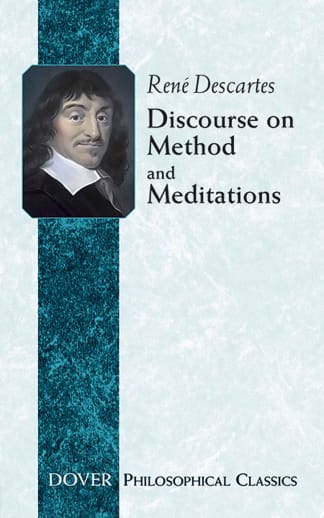
Rene Descartes, considered the father of modern philosophy and the founder of the rational method, asks the question, “Is it possible to be certain of anything, and if so, how?” in this classic philosophical work. Descartes rejected the limitations of traditional philosophy and theology, instead favoring logic, geometry, and algebra and focusing on a scientific approach. The discourse is divided into six sections—consideration of the sciences; rules for the method he developed; rules of morality; the existence of God proven; questions regarding physics; and further questions. Following the discourse, the meditation is also divided into six meditations on similar and related topics. Descartes’ main aim is to prove that the mind is the true source of scientific knowledge, as opposed to the senses, and that science and religion are compatible. Note that the text in this book is fairly small.
Discourse on the Method and Meditations (Dover Philosophical Classics)
SKU
012110
ISBN
9780486432526
Grade 9-AD
These icons are designed to help you quickly understand and learn important information about our products.
Teaching Method
Traditional
Teacher-centered curriculum commonly used in classrooms that may include a text, teacher manual, tests, etc.
Charlotte Mason
A methodology based on the work of a 19th century educator who maintained that children learn best from literature (Living Books), not textbooks.
Classical
A methodology based on the Latin Trivium (three stages of learning), including the grammar stage (memorization and facts), logic stage (critical thinking), and rhetoric stage (developing/defending ideas).
Unit Study
A thematic or topical approach centered around one topic that integrates multiple subject areas.
Montessori (Discovery)
A methodology based on the work of a 20th century educator that emphasizes student and sensory-driven discovery learning and real-life applications.
Other
Other methodologies
Religious Content
Secular
Contains content contrary to common Christian beliefs (i.e. evolution).
Neutral
Avoids religious or theoretical topics or presents multiple viewpoints without preference.
Christian/Religious
Faith-based or including instructional religious content.
Learning Modality
Auditory
Learns through listening, talking out loud or reading out loud.
Visual
Learns through seeing, prefers written instructions and visual materials.
Kinesthetic/Tactile (Hands-On)
Learns through moving, doing and touching.
Multi-Sensory
Curriculum that employ a variety of activities/components.
Presentation
Sequential
Curriculum progresses through well-defined learning objectives. Emphasizes mastery before moving to the next topic.
Spiral
Topics and concepts are repeated from level to level, adding more depth at each pass and connecting with review.
Conceptual/Topical
Focus is on the “why,” often with a unifying concept as well as specific skills; coverage may be broader.
Teacher Involvement
Low Teacher Involvement
Student-led materials; parent acts as a facilitator.
Medium Teacher Involvement
A mix of teacher-led time and independent student work.
High Teacher Involvement
Teacher-led lessons; may utilize discussions, hands-on activities and working together.
Additional Materials Required
No other materials needed
Everything you need is included.
Other Materials Required
There are additional required resources that are a separate purchase.
Other Materials Optional
There are additional resources mentioned or recommended but are not absolutely necessary.
Consumable
Consumable
Designed to be written in; not reusable.
Non-Consumable
Not designed to be written in; reusable.
Our Price
$8.95 $8.95 $7.25
Rainbow Savings: $1.70
Product Overview
- Rene Descartes is considered the father of modern philosophy and asks the question “Is it possible to be sure of anything?”
- Divided into two parts—discourse and meditation—that are each divided into six sections
- The main goal of the book is to present the mind as the true source of scientific knowledge and to prove that science and religion are compatible
Description
Publisher's Description of Discourse on the Method and Meditations (Dover Philosophical Classics)
Is it possible to be certain of anything? If so, how? The father of modern philosophy and the founder of rational method in philosophical thought, René Descartes (1596–1650) sought the answers to these questions and in doing so, addressed the most important of methods of thinking and understanding truth. In Discourse on Method, he applies a scientific approach to philosophy that comprises four principles: to accept only what reason recognizes as "clear and distinct"; to analyze complex ideas by dividing them into smaller elements; to reconstruct the ideas; and to make accurate and complete enumerations of the data. His Meditations proceed according to this method, exploring the mind/body distinction, the nature of truth and error, the existence of God, and the essence of material things.
Reprint of Discourse and Meditations from The Philosophical Works of Descartes, Cambridge University Press, 1911.
Reprint of Discourse and Meditations from The Philosophical Works of Descartes, Cambridge University Press, 1911.
Details
| Product Format: | Paperback Book |
|---|---|
| Grades: | 9-AD |
| Brand: | Dover Publications |
| Author: | Rene Descartes |
| ISBN: | 9780486432526 |
| Length in Inches: | 8 |
| Width in Inches: | 5 |
| Height in Inches: | 0.25 |
| Weight in Pounds: | 0.3 |
Videos
Reviews