
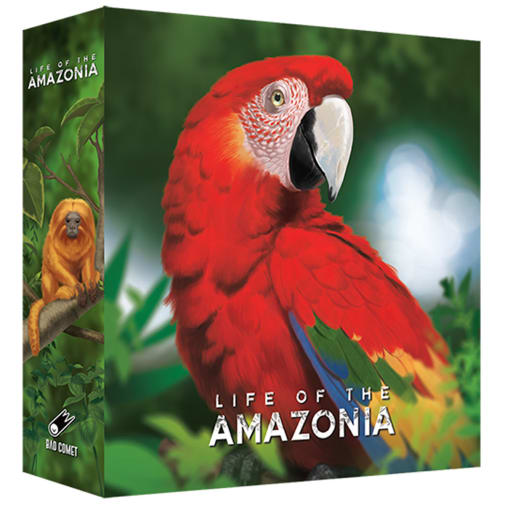
Life of the Amazonia Game

SKU
011909
Grade 9-AD
Teaching Method
Traditional
Teacher-centered curriculum commonly used in classrooms that may include a text, teacher manual, tests, etc.
Charlotte Mason
A methodology based on the work of a 19th century educator who maintained that children learn best from literature (Living Books), not textbooks.
Classical
A methodology based on the Latin Trivium (three stages of learning), including the grammar stage (memorization and facts), logic stage (critical thinking), and rhetoric stage (developing/defending ideas).
Unit Study
A thematic or topical approach centered around one topic that integrates multiple subject areas.
Montessori (Discovery)
A methodology based on the work of a 20th century educator that emphasizes student and sensory-driven discovery learning and real-life applications.
Other
Other methodologies
Religious Content
Secular
Contains content contrary to common Christian beliefs (i.e. evolution).
Neutral
Avoids religious or theoretical topics or presents multiple viewpoints without preference.
Christian/Religious
Faith-based or including instructional religious content.
Learning Modality
Auditory
Learns through listening, talking out loud or reading out loud.
Visual
Learns through seeing, prefers written instructions and visual materials.
Kinesthetic/Tactile (Hands-On)
Learns through moving, doing and touching.
Multi-Sensory
Curriculum that employ a variety of activities/components.
Presentation
Sequential
Curriculum progresses through well-defined learning objectives. Emphasizes mastery before moving to the next topic.
Spiral
Topics and concepts are repeated from level to level, adding more depth at each pass and connecting with review.
Conceptual/Topical
Focus is on the “why,” often with a unifying concept as well as specific skills; coverage may be broader.
Teacher Involvement
Low Teacher Involvement
Student-led materials; parent acts as a facilitator.
Medium Teacher Involvement
A mix of teacher-led time and independent student work.
High Teacher Involvement
Teacher-led lessons; may utilize discussions, hands-on activities and working together.
Additional Materials Required
No other materials needed
Everything you need is included.
Other Materials Required
There are additional required resources that are a separate purchase.
Other Materials Optional
There are additional resources mentioned or recommended but are not absolutely necessary.
Consumable
Consumable
Designed to be written in; not reusable.
Non-Consumable
Not designed to be written in; reusable.
Our Price
$73.00 $73.00 $65.00
Rainbow Savings: $8.00
Warning
Choking Hazard
  • Small parts. Not for children under 3 years.

Description

In the Amazon, animals and plants must coexist to have a thriving biome and ensure the health of the rainforest. In Life of the Amazonia, players compete to develop thriving communities of various animals and plant life that best exemplify what the environment needs to succeed for future generations. Join in this beautiful board game experience with 2-4 players or experience the solo mode. Immerse yourself in the diversity of options and goals as you strive to earn victory points for building your own jungle environment from the ground up and populating it with various species of plants and animals.

In this game, the goal is to build a terrain and place animals and plants in patterns that earn the most points at game end. There are 8 base animal cards that have four different sets, varying in difficulty, and requirements for how each animal needs to be placed in an environment and in interaction with plants and other animals to score points at the end of the game. Once a set of cards is chosen, its corresponding animal meeples are placed on the card based on player count. These meeples are claimed by players to place in their environments when they can purchase them for their indicated required resources. The resources used to purchase them are leaves, water, and fruit, which can be purchased with coins. Each person also has a unique animal that provides specific abilities and resources.

Besides gaining points from your terrain animal and plant placement, nature cards can be purchased with coins during the game that provide various goals, such as the number of birds in a player’s rainforest, to provide end-game points. When five of the eight base animal meeples have all been placed in players’ terrains, the game ends and the person who has the most points wins! What makes this game stand out for me is the use of different game mechanics (bag building, set collection, and tile and pattern building) that work together to support a cohesive, multi-dimensional game play with unique combinations of goals in different games. The components and artwork are beautiful, and the game manual contains well-illustrated directions and an informative appendix that explains different cards and goals. There are variant modes and solo instructions. For 1-4 players with a 60–150-minute game time. ~Marsha

Publisher's Description of Life of the Amazonia Game
Life of the Amazonia’ is a strategic meeple placing game that combines bag building and pattern building. Players will restore land, place various animals, and plant trees and flowers to enrich their jungles and create the most ecologically rich jungle. Various lives must be placed in the jungle taking into account each unique characteristic of the plants and animals in order to create synergies within one another. With 60,000+ various ways to set up the animal cards and diverse strategic options, every game of ‘Life of Amazonia’ will differ from the next.
Details
More Information
Product Format:Other
Grades:9-AD
Brand:Bad Comet Games
EAN/UPC:8809597071408
Length in Inches:11.6875
Width in Inches:11.6875
Height in Inches:2.875
Weight in Pounds:4.25
Videos
This product doesn't have a video
Reviews
Product Q&A