
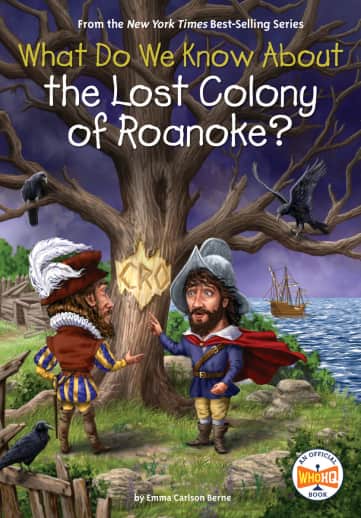
What Do We Know About the Lost Colony of Roanoke?

SKU
009997
ISBN
9780593752081
Grade 3-7
Teaching Method
Traditional
Teacher-centered curriculum commonly used in classrooms that may include a text, teacher manual, tests, etc.
Charlotte Mason
A methodology based on the work of a 19th century educator who maintained that children learn best from literature (Living Books), not textbooks.
Classical
A methodology based on the Latin Trivium (three stages of learning), including the grammar stage (memorization and facts), logic stage (critical thinking), and rhetoric stage (developing/defending ideas).
Unit Study
A thematic or topical approach centered around one topic that integrates multiple subject areas.
Montessori (Discovery)
A methodology based on the work of a 20th century educator that emphasizes student and sensory-driven discovery learning and real-life applications.
Other
Other methodologies
Religious Content
Secular
Contains content contrary to common Christian beliefs (i.e. evolution).
Neutral
Avoids religious or theoretical topics or presents multiple viewpoints without preference.
Christian/Religious
Faith-based or including instructional religious content.
Learning Modality
Auditory
Learns through listening, talking out loud or reading out loud.
Visual
Learns through seeing, prefers written instructions and visual materials.
Kinesthetic/Tactile (Hands-On)
Learns through moving, doing and touching.
Multi-Sensory
Curriculum that employ a variety of activities/components.
Presentation
Sequential
Curriculum progresses through well-defined learning objectives. Emphasizes mastery before moving to the next topic.
Spiral
Topics and concepts are repeated from level to level, adding more depth at each pass and connecting with review.
Conceptual/Topical
Focus is on the “why,” often with a unifying concept as well as specific skills; coverage may be broader.
Teacher Involvement
Low Teacher Involvement
Student-led materials; parent acts as a facilitator.
Medium Teacher Involvement
A mix of teacher-led time and independent student work.
High Teacher Involvement
Teacher-led lessons; may utilize discussions, hands-on activities and working together.
Additional Materials Required
No other materials needed
Everything you need is included.
Other Materials Required
There are additional required resources that are a separate purchase.
Other Materials Optional
There are additional resources mentioned or recommended but are not absolutely necessary.
Consumable
Consumable
Designed to be written in; not reusable.
Non-Consumable
Not designed to be written in; reusable.
Our Price
$6.99 $6.99 $5.50
Rainbow Savings: $1.49

Description

Publisher's Description of What Do We Know About the Lost Colony of Roanoke?

It is . . .
The very first permanent English settlement in the Americas, established by Sir Walter Raleigh in 1585
A colony of over one hundred people that seemed to suddenly vanish without a trace
One of the longest unsolved mysteries of North America

Find out what really happened when an entire colony disappeared in 1590, just five years after it was founded. What is the truth about the missing members of the lost colony of Roanoke?

In 1585, Sir Walter Raleigh attempted to found the very first permanent English settlement in the Americas. The initial settlement—called the Lane colony—failed due to extremely low supplies and a hostile relationship with the Native American people who were already living on the land. Despite this miserable first attempt, Raleigh decided to establish another settlement. Over one hundred people agreed to join this new colony on Roanoke Island, just off the coast of what is now North Carolina. The colony’s governor, John White, chose to return to England to get more supplies but found himself stuck there for three years due to an unexpected war. When he arrived back at Roanoke, the entire colony had vanished. Over one hundred people, including his wife and daughter, had seemingly disappeared. They were never heard from again. The only clue left was the word “Croatoan” carved into a post. What really happened to the missing English settlers? Find out what we do know about this historic unsolved mystery in this nonfiction book for young readers.

Learning history is so much more than dry boring facts regurgitated to fill in worksheets and quizzes. Rather, learning history should be about understanding the people and events of people - people who are just like us, people who have experienced events that changed their life as they knew it.

Covering a variety of American history events that have changed our world, this well-written series will engage children and help them understand the impact of the events that occurred during each time period. Black and white illustrations, maps, and sixteen pages of authentic photos bring a real-life experience to our children. Timelines and a bibliography are also included to enhance learning. These would make wonderful read-aloud or engage children in self-reading. An appealing supplement to any history program or to keep learning fresh through the summer. PB. 106 pgs. ~Deanne

Details
More Information
Product Format:Paperback
Grades:3-7
Brand:Random House Books for Young Readers
Author:Emma Carlson Berne
ISBN:9780593752081
Length in Inches:7.625
Width in Inches:5.375
Height in Inches:0.25
Weight in Pounds:0.2
Videos
This product doesn't have a video
Reviews
Product Q&A