
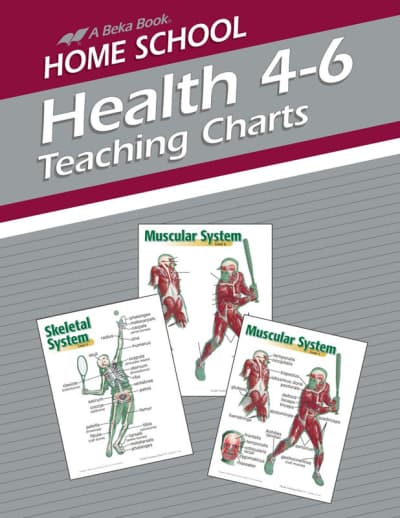
The Homeschool Science Grades 4-6 Teaching Charts are optional, but helpful. Measuring 8 ½" x 11" the colorful, glossy visual aids come in a soft covered book. Perforated for ease of use, the double-sided charts (one side labeled with the flip side unlabeled), cover parts of the insect, trees, the water cycle and the solar system. Charts are used in grades 4, 5 and 6, making this a great value for families. If you plan to use them for consecutive years, you may wish to place them in page protectors for longer durability.
Abeka Health 4-6 Homeschool Teaching Charts
SKU
009246
ISBN
9780000108937
Grade 4
These icons are designed to help you quickly understand and learn important information about our products.
Teaching Method
Traditional
Teacher-centered curriculum commonly used in classrooms that may include a text, teacher manual, tests, etc.
Charlotte Mason
A methodology based on the work of a 19th century educator who maintained that children learn best from literature (Living Books), not textbooks.
Classical
A methodology based on the Latin Trivium (three stages of learning), including the grammar stage (memorization and facts), logic stage (critical thinking), and rhetoric stage (developing/defending ideas).
Unit Study
A thematic or topical approach centered around one topic that integrates multiple subject areas.
Montessori (Discovery)
A methodology based on the work of a 20th century educator that emphasizes student and sensory-driven discovery learning and real-life applications.
Other
Other methodologies
Religious Content
Secular
Contains content contrary to common Christian beliefs (i.e. evolution).
Neutral
Avoids religious or theoretical topics or presents multiple viewpoints without preference.
Christian/Religious
Faith-based or including instructional religious content.
Learning Modality
Auditory
Learns through listening, talking out loud or reading out loud.
Visual
Learns through seeing, prefers written instructions and visual materials.
Kinesthetic/Tactile (Hands-On)
Learns through moving, doing and touching.
Multi-Sensory
Curriculum that employ a variety of activities/components.
Presentation
Sequential
Curriculum progresses through well-defined learning objectives. Emphasizes mastery before moving to the next topic.
Spiral
Topics and concepts are repeated from level to level, adding more depth at each pass and connecting with review.
Conceptual/Topical
Focus is on the “why,” often with a unifying concept as well as specific skills; coverage may be broader.
Teacher Involvement
Low Teacher Involvement
Student-led materials; parent acts as a facilitator.
Medium Teacher Involvement
A mix of teacher-led time and independent student work.
High Teacher Involvement
Teacher-led lessons; may utilize discussions, hands-on activities and working together.
Additional Materials Required
No other materials needed
Everything you need is included.
Other Materials Required
There are additional required resources that are a separate purchase.
Other Materials Optional
There are additional resources mentioned or recommended but are not absolutely necessary.
Consumable
Consumable
Designed to be written in; not reusable.
Non-Consumable
Not designed to be written in; reusable.
Our Price
$16.90 Description
Publisher's Description of Abeka Health 4-6 Homeschool Teaching Charts
These 22 brightly colored health teaching visuals (labeled on front and unlabeled on the back) come in one handy book. They correlate with grades 4–6 Homeschool Science/Health Curriculum/Lesson Plans. The unlabeled side is great for reviews. The perforated pages make it easy to remove individual pages to display on the wall. The 8½" x 11" size makes it easy to store detached pages in page protectors.
Featured Topics
* Food Guide Pyramid
* A Tooth's Structure
* Skeletal System
* Muscular System
* Respiratory System
* Skin
* Circulatory System
* Digestive System
* Nervous System
* Lymphatic System
* Endocrine System
Category Description for Abeka Science Grade 6
Bridging elementary and Jr. High Science, Observing God's World presents the Universe as God's unique creation and refutes the theory of evolution. Plants, invertebrates, the earth's structure, space, and introductory chemistry are all studied. Students are also introduced to Christians with innovative, scientific thinking. The student textbook provides textual readings, chapter comprehension and end of chapter checks, and activities. Activities vary from research to observation and hands-on experiments. If you plan to incorporate the hands-on experiments, there are some household items and lab supplies that will be needed. For example: bar magnet, aquarium, critter habitat, protozoa hatchery kit, and a microscope (400x). Space to record answers is not included, so students will need a separate notebook. Also available is the Observing God's World Answer Key with answers for each comprehension and end of chapter question (questions are included). NEW ADD Homeschool Science and Health 6 Curriculum Lesson Plans provide detailed, day-by-day lesson plans, teaching tips, homework suggestions, games, bible memorization and other enrichment ideas for a 25-week study of Science, and 9- week study of health. Daily lessons average 30 minutes, although some children may need longer.
Additional resources include the quiz and worksheet book, test book, and their companion but separate answer keys. The quiz and worksheet book contains 25 quizzes and 22 worksheets (no answers). Answers are found in the Quiz and Worksheet Answer Key. The test book contains 8-unit tests, and 3 nine-weeks exams. Test questions vary from fill in the blank, true or false, matching/labeling and short answer questions. Answers are found in the test book answer key. The test book and the quiz and worksheet book are not reproducible, each student will need their own book.
Also available are the Grade 6 Science and Health Parent and Child Kits. Both are recommended for successful teaching. The parent kit includes the Homeschool Science and Health 6 Curriculum Lesson Plans, Observing God's World Answer Key, Test Key, Quiz and Worksheet Key, the Choosing Good Health Answer Key and the Quiz, Test, and Worksheet Key. The child kit includes the Observing God's World textbook, Test Book, Quiz and Worksheet Book, the Choosing Good Health text and the Quiz, Test, and Worksheet Book.
Details
| Product Format: | Paperback |
|---|---|
| Grade: | 4 |
| Brand: | Abeka |
| ISBN: | 9780000108937 |
| Length in Inches: | 11 |
| Width in Inches: | 8.5 |
| Height in Inches: | 0.0625 |
| Weight in Pounds: | 0.2 |
Videos
Reviews