
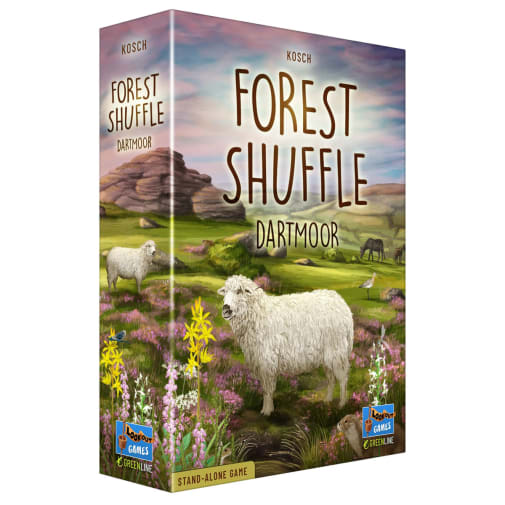

Experience the vast Moorlands of southern England when you play Forest Shuffle Dartmoor by Lookout Games. With its rugged terrain, river valleys, ancient woodlands, and archeological sites, it is home to various birds, dragonflies, Dartmoor sheep, lizards, and bats, among many other native species. Like the original Forest Shuffle Game, Dartmoor is a stand-alone card-drafting, tableau-building game that uses a beautifully illustrated deck of cards. Players use cards to build an environment consisting of trees, shrubs, moorland terrains, and many plants and animals who reside alongside each other.
There are two other types of cards used in the game. Each player has a cave card, on which some wildlife and fauna card actions let players discard cards to gain one point each at the end of the game. Also, there are three winter cards that are placed into the lower third of the gameplay card deck. When the third winter card is drawn, the game immediately ends.
The other key component of Forest Shuffle is the clearing,
which is an area where players add cards to under two conditions during
gameplay. See the section below for details.
Basic gameplay is as follows, with one of two choices taken by players each
turn:
- Draw two cards from the clearing or the deck. Players may only have ten cards in their hand at any one time.
- Play a card and check the clearing. The first card played in everyone’s forest tableau is a tree, shrub, or terrain (moor). If there is a cost to play a card, pay its cost by discarding that number of cards from your hand into the clearing. Each time a tree, shrub, or moorland card is played, an additional card is drawn from the deck and placed in the clearing. If there are 10 cards in the clearing, remove all of them and place in a discard pile.
Playing a Tree, Shrub, or Terrain (Moorland) card: There are several varieties of each, with different costs, benefits, and end-game points. Trees and shrubs provide card slots above, below, and on each of its sides to place creature and plant life around it. Terrain (Moorland) cards provide two slots above and two below but none on their sides. Some species cards (animal and plant) specify they must be placed in a moorland. All species cards are split in half from top to bottom or side to side and contain two choices of wildlife. Play a card in an empty slot on one of the four sides of a tree, shrub, or moorland in your tableau. There may be immediate or ongoing benefits and/or game-end points from these cards.
Once the third winter card is drawn, the game ends, all players tally their points, and the person with the highest score wins! For 2-5 players with a 60-minute playtime. See the appendix document provided on this web page for detailed card explanations. ~ Marsha