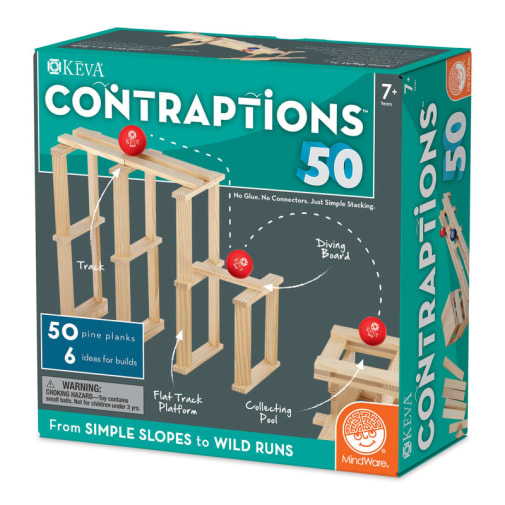
Create structures by stacking wooden planks together—no glue or connectors required! The kit includes a full-color idea booklet, two lightweight KEVA balls, and 50 pine planks.
KEVA Contraptions Pine 50 Plank Set
SKU
007761
Grade 2-AD
These icons are designed to help you quickly understand and learn important information about our products.
Teaching Method
Traditional
Teacher-centered curriculum commonly used in classrooms that may include a text, teacher manual, tests, etc.
Charlotte Mason
A methodology based on the work of a 19th century educator who maintained that children learn best from literature (Living Books), not textbooks.
Classical
A methodology based on the Latin Trivium (three stages of learning), including the grammar stage (memorization and facts), logic stage (critical thinking), and rhetoric stage (developing/defending ideas).
Unit Study
A thematic or topical approach centered around one topic that integrates multiple subject areas.
Montessori (Discovery)
A methodology based on the work of a 20th century educator that emphasizes student and sensory-driven discovery learning and real-life applications.
Other
Other methodologies
Religious Content
Secular
Contains content contrary to common Christian beliefs (i.e. evolution).
Neutral
Avoids religious or theoretical topics or presents multiple viewpoints without preference.
Christian/Religious
Faith-based or including instructional religious content.
Learning Modality
Auditory
Learns through listening, talking out loud or reading out loud.
Visual
Learns through seeing, prefers written instructions and visual materials.
Kinesthetic/Tactile (Hands-On)
Learns through moving, doing and touching.
Multi-Sensory
Curriculum that employ a variety of activities/components.
Presentation
Sequential
Curriculum progresses through well-defined learning objectives. Emphasizes mastery before moving to the next topic.
Spiral
Topics and concepts are repeated from level to level, adding more depth at each pass and connecting with review.
Conceptual/Topical
Focus is on the “why,” often with a unifying concept as well as specific skills; coverage may be broader.
Teacher Involvement
Low Teacher Involvement
Student-led materials; parent acts as a facilitator.
Medium Teacher Involvement
A mix of teacher-led time and independent student work.
High Teacher Involvement
Teacher-led lessons; may utilize discussions, hands-on activities and working together.
Additional Materials Required
No other materials needed
Everything you need is included.
Other Materials Required
There are additional required resources that are a separate purchase.
Other Materials Optional
There are additional resources mentioned or recommended but are not absolutely necessary.
Consumable
Consumable
Designed to be written in; not reusable.
Non-Consumable
Not designed to be written in; reusable.
Our Price
$26.99 Product Overview
- Stack wooden planks together to create structures; no glue or connectors required
- Includes a full-color booklet, two KEVA balls, and 50 wooden planks
Warning
Choking Hazard
- Small parts. Not for children under 3 years.
- Toy contains a marble. Not for children under 3 years.
Description
Publisher's Description of KEVA Contraptions Pine 50 Plank Set
No glue or connectors required...simply stack wood planks to create buildings, monuments and geometric forms. Its the ideal activity to help kids gain an understanding of balance and proportion, as well as an interest in architecture, building and design. A full-color idea booklet with build-out instructions and two lightweight KEVA balls are included. The Benefits of Maple: Premium maple planks are tough, durable and stack perfectly time after time. Beautiful maple wood grain creates works of art. KEVA Maple Planks are proudly made in the U.S.A.
Category Description for KEVA Planks
KEVA planks come in two precision-cut versions: maple or pine. Each Contraptions set includes planks, an idea book and 2 bouncy KEVA balls (roughly the weight and shape of ping pong balls) to roll down paths, drop down shafts, and deflect around U-turns that you build. Think movement: marble runs, aqueducts, and roller coasters. Models sets include 154 planks, base plates, and instructions. These sets let you build specific types of models, such as vehicles and monuments. The Structures sets are intended more for architectural design - bridges, monuments, towers and more. Structures sets include planks and idea books, but no rubber balls. It's all about balance and stability with any set you choose - no glue, no connectors - just a steady hand, patience, and a vivid imagination!
Details
| Product Format: | Other |
|---|---|
| Grades: | 2-AD |
| Brand: | MindWare |
| EAN/UPC: | 736970480015 |
| Length in Inches: | 8.25 |
| Width in Inches: | 8.25 |
| Height in Inches: | 2.75 |
| Weight in Pounds: | 1.75 |
Videos
Reviews