
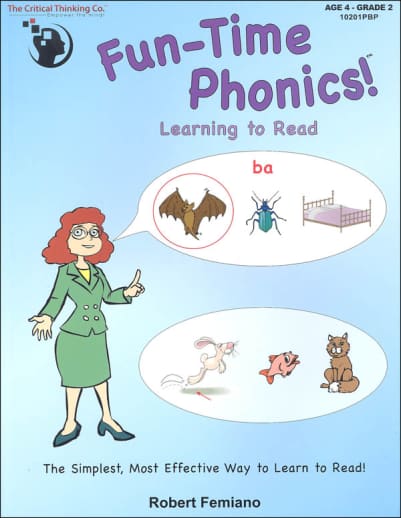

This colorful, straightforward instructional workbook from The Critical Thinking Company eliminates much of the "stuff" and the "fluff" found in many other phonics and early reading programs and focuses on individual letter sounds and how they are represented as letters. You won't find pages of teacher tips and background here, just one introductory page and one teaching suggestion page, and then you're off and running to the activities. Similar in format to Mathematical Reasoning, Fun-Time Phonics is softcover, with several exercises per activity page, brief instructions to the teacher, and full-color illustrated graphics.
There are 100 activities, or short lessons, in the book. The first seven lay the foundation by asking the student to identify beginning sounds, ending sounds, and rhyming words. Activities 6 and 7 challenge them to identify the three letter sounds in a word and to match that with the correct picture. Starting in Activity 8, students learn the short vowel sounds and identify pictures of words that contain that sound. Before moving on to the consonant sounds, students complete activities such as identifying a word out of a set of three that includes a different vowel sound than the other two, or swapping out one vowel sound for another in a word to create a new word. After students learn the five short vowel sounds, they learn the written vowel letters. One feature in the vowel portion of the book that threw me for a loop, however, was the depiction of a short "//' sound as "/ah/' next to words like, "cat." Most phonics programs are quite clear to teachers to take care when pronouncing the vowel and consonant sounds to not include other sounds (say "/b/,' not "/buh/'). At first glance, you will want to read the "/ah/' as the /a/ in "father." Personally, I would probably just ignore these additional "h's or cross them out and add a short vowel symbol as a reminder. Fortunately, as these only occur on the teacher instructions, it shouldn't confuse your students as long as your pronunciation is clear. Lesson 20 moves on to consonant sounds, starting with "b' and moving alphabetically through "z.' As children learn each consonant, the consonant sound is blended with each of the short vowels, so they are learning to distinguish "da,' "de,' "di,' "do,' and "du' with the letter D right off the bat. This may be a real benefit to students who are confused about how to blend the individual letter sounds together after learning them in isolation. The last five lessons ask the student to connect a picture with the beginning letters, ending letters and middle vowel wounds, stressing the letter representation of the sound. The last two activities ask children to read three-letter CVC words and identify a matching picture. At the end of the book you'll find a double-sided sheet with short-vowel words that children should be able to decode at this point, such as "doll, "hen' and "yum.'
This approach would work well with logical children who do not need additional reinforcement activities or motivators in the form of games or songs. It may also work well for remedial students, or those who did not learn phonics initially. It's simple to teach, but with an emphasis on identifying letter sounds, you will want to work apart from other distractions and enunciate the words very clearly as you work through the pages with your student. Although students are led to associate the written letters with the sounds, there are no writing activities featured in the book. However, it is suggested in the beginning that if the student is older or able to write, you may consider having them write the answers under the exercises. For additional enforcement (and writing activities) you might consider a workbook like Explode the Code Book 1. You may also want to note that no sight words are covered in this volume. If you want to jump ahead to some very basic short-vowel readers, you will need to introduce any sight words in that reader. I'm assuming that a second book will be released as a follow-up which will introduce long vowel sounds. The book is reproducible for your student/classroom use, which makes an affordable resource even more budget-friendly if you use it with multiple children. 314 pages, pb. - Jess