These icons are designed to help you quickly understand and learn important information about our products.
Teaching Method
Traditional
Teacher-centered curriculum commonly used in classrooms that may include a text, teacher manual, tests, etc.
Charlotte Mason
A methodology based on the work of a 19th century educator who maintained that children learn best from literature (Living Books), not textbooks.
Classical
A methodology based on the Latin Trivium (three stages of learning), including the grammar stage (memorization and facts), logic stage (critical thinking), and rhetoric stage (developing/defending ideas).
Unit Study
A thematic or topical approach centered around one topic that integrates multiple subject areas.
Montessori (Discovery)
A methodology based on the work of a 20th century educator that emphasizes student and sensory-driven discovery learning and real-life applications.
Other
Other methodologies
Religious Content
Secular
Contains content contrary to common Christian beliefs (i.e. evolution).
Neutral
Avoids religious or theoretical topics or presents multiple viewpoints without preference.
Christian/Religious
Faith-based or including instructional religious content.
Learning Modality
Auditory
Learns through listening, talking out loud or reading out loud.
Visual
Learns through seeing, prefers written instructions and visual materials.
Kinesthetic/Tactile (Hands-On)
Learns through moving, doing and touching.
Multi-Sensory
Curriculum that employ a variety of activities/components.
Presentation
Sequential
Curriculum progresses through well-defined learning objectives. Emphasizes mastery before moving to the next topic.
Spiral
Topics and concepts are repeated from level to level, adding more depth at each pass and connecting with review.
Conceptual/Topical
Focus is on the “why,” often with a unifying concept as well as specific skills; coverage may be broader.
Teacher Involvement
Low Teacher Involvement
Student-led materials; parent acts as a facilitator.
Medium Teacher Involvement
A mix of teacher-led time and independent student work.
High Teacher Involvement
Teacher-led lessons; may utilize discussions, hands-on activities and working together.
Additional Materials Required
No other materials needed
Everything you need is included.
Other Materials Required
There are additional required resources that are a separate purchase.
Other Materials Optional
There are additional resources mentioned or recommended but are not absolutely necessary.
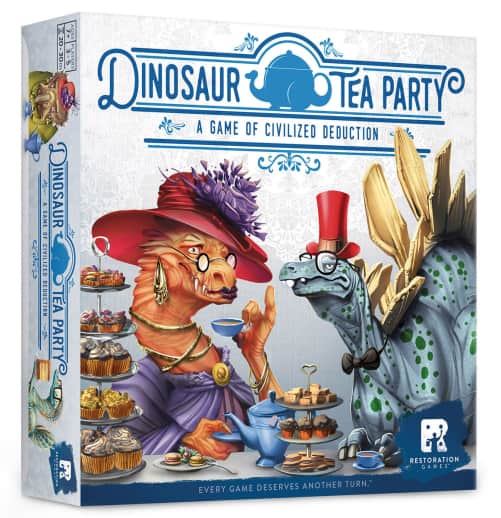
Carlton has a drink and a pet while Gerald has food and
wears a hat. What do they have in common? They are both dinosaurs attending a
tea party, and you are invited to join them as a fellow dinosaur to participate
in a friendly social deduction game. Some dinosaurs might lie to you or always
answer your inquiries with a “no”, but if you ask enough questions, you can
figure out your fellow dinosaur’s names as they also try to guess who you are.
When someone guesses another dinosaur’s identity, they collect a sugar cube.
The revealed dinosaur changes identities and the game continues until a player
has three sugar cubes for the win!
Dinosaur Tea Party is a nice entry-level game for the whole family to
practice logic thinking skills and have fun bantering with each other as charismatic
dinosaurs at a pretend tea party. For 3-5 players with a 20–30-minute play
time.
Publisher's Description of Dinosaur Tea Party: A Game of Civilized Deduction
It's the most sought-after invitation of the year: Dinoton Abbey for
high tea. Now you're all gussied up in your bespoke finery and sporting
the hottest fascinator straight from Savile Row. There's just one
problem: You can't remember anyone's name. Who's that, sporting the
fancy brooch and toting along her pet chicken? Is that Jeannine?
Beatriz? Oh dear. If you're not careful, you'll commit a faux pas that
will quickly find its way into the gossip pages of the Raptor's Home
Quarterly.
Dinosaur Tea Party is a thorough reimagining of
Whosit?, the 1967 identity-guessing game. Each player is a dinosaur with
a hidden identity. Players take turns asking each other questions to
figure them out. “Pardon me for asking, but are you wearing a hat?”
“What lovely camouflage you're sporting. Are those spots?” When a player
thinks they've figured everybody out, they announce their guesses. The
other players indicate whether they're correct by dropping their sugar
cubes into the dino teapot, which cleverly reveals if any of the guesses
are wrong but not which ones. The first player to deduce everyone's
name wins the game and is sure to be invited back for Sunday supper.