
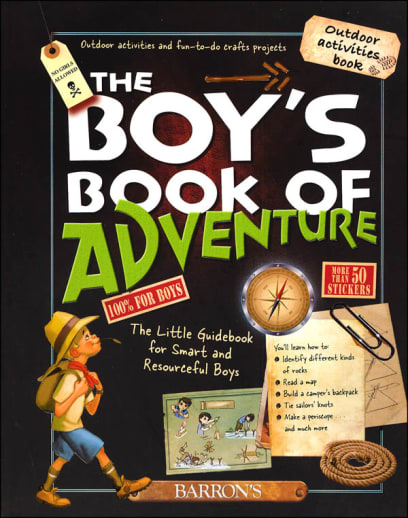
Includes: in-depth information about bugs; making a floating compass; shells and rocks; first aid; cracking (and making) codes; map reading; determining what the weather will be like through weather crafts; and much more!
Boy's Book of Adventure
SKU
004569
ISBN
9780764166112
Grade 3-7
These icons are designed to help you quickly understand and learn important information about our products.
Teaching Method
Traditional
Teacher-centered curriculum commonly used in classrooms that may include a text, teacher manual, tests, etc.
Charlotte Mason
A methodology based on the work of a 19th century educator who maintained that children learn best from literature (Living Books), not textbooks.
Classical
A methodology based on the Latin Trivium (three stages of learning), including the grammar stage (memorization and facts), logic stage (critical thinking), and rhetoric stage (developing/defending ideas).
Unit Study
A thematic or topical approach centered around one topic that integrates multiple subject areas.
Montessori (Discovery)
A methodology based on the work of a 20th century educator that emphasizes student and sensory-driven discovery learning and real-life applications.
Other
Other methodologies
Religious Content
Secular
Contains content contrary to common Christian beliefs (i.e. evolution).
Neutral
Avoids religious or theoretical topics or presents multiple viewpoints without preference.
Christian/Religious
Faith-based or including instructional religious content.
Learning Modality
Auditory
Learns through listening, talking out loud or reading out loud.
Visual
Learns through seeing, prefers written instructions and visual materials.
Kinesthetic/Tactile (Hands-On)
Learns through moving, doing and touching.
Multi-Sensory
Curriculum that employ a variety of activities/components.
Presentation
Sequential
Curriculum progresses through well-defined learning objectives. Emphasizes mastery before moving to the next topic.
Spiral
Topics and concepts are repeated from level to level, adding more depth at each pass and connecting with review.
Conceptual/Topical
Focus is on the “why,” often with a unifying concept as well as specific skills; coverage may be broader.
Teacher Involvement
Low Teacher Involvement
Student-led materials; parent acts as a facilitator.
Medium Teacher Involvement
A mix of teacher-led time and independent student work.
High Teacher Involvement
Teacher-led lessons; may utilize discussions, hands-on activities and working together.
Additional Materials Required
No other materials needed
Everything you need is included.
Other Materials Required
There are additional required resources that are a separate purchase.
Other Materials Optional
There are additional resources mentioned or recommended but are not absolutely necessary.
Consumable
Consumable
Designed to be written in; not reusable.
Non-Consumable
Not designed to be written in; reusable.
Our Price
$14.99 $14.99 $11.50
Rainbow Savings: $3.49
Description
Publisher's Description of Boy's Book of Adventure
Here's an exciting book packed with facts about nature, ideas for outdoor activities, and fun-to-do crafts projects that will keep boys interested and busy all year around. It's filled with color illustrations and diagrams that teach kids:
- How to recognize different kinds of insects and observe their activities
- How to identify different kinds of rocks
- How to read a topographic map
- How to construct a camper's backpack How to tie sailors' knots
- How to build a periscope . . . and much more
Camping advice and instruction includes ways to protect against the weather, first-aid for injuries, advice on using a compass, tips for studying the night sky, identifying birds, and much more. The book's wide array of topics and sturdy construction makes it an ideal outdoor companion for hiking and camping excursions. An elastic band bound into the back cover can be stretched over pages and used as a place marker. Color illustrations on every page. (Ages 8-12)
Hardcover w/hidden spiral binding / 128 Pages / 7 1/4 x 8 1/4 / 2013
Category Description for Books of Adventure
Adventure should never be limited to explorers, scientists, artists, or even adults! Kids need just as much opportunity to explore the world around them. These books of adventure fill a very necessary gap in schooling-arts, crafts, education, science and nature rolled into two books. Each book is divided into roughly 40 two-four page lessons, craft activities, or general information about select topics. An informational lesson in the Boy's Book may talk about "First Aid," covering several minor injuries (such as stings, cuts, heatstroke, and small burns) and how to treat them quickly. Other topics include craft projects-one example from the Girl's Book is an in-depth craft activity about making tire and board swings. Every topic is accompanied by fun, full-color cartoon illustrations to help guide kids and hold their interest.
The majority of Boy's Book focuses on outdoor exploration, crafts, and tips, while the Girl's Book tends to involve more household and artistic activities. While these are topics traditionally associated with boys or girls, don't let semantics hold your child back! If you have a girl more interested in hiking and the great outdoors than cooking and fashion, or a boy interested in gardening and photography, ignore the cover and let them go wild!
Details
| Product Format: | Hardcover |
|---|---|
| Grades: | 3-7 |
| Brand: | Barron's Educational Series |
| ISBN: | 9780764166112 |
| Length in Inches: | 8.375 |
| Width in Inches: | 7.375 |
| Height in Inches: | 1 |
| Weight in Pounds: | 1.5 |
Videos
Reviews