
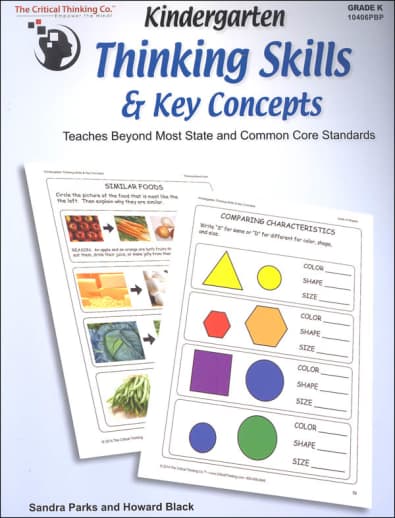

At the Kindergarten level, the consumable Thinking Skills and Key Concepts Student Book helps children develop key skills using familiar topics and concepts. From describing colors and shapes to similarities and differences and sequencing, children apply these skills to family members, foods, animals and more. Activities are multisensory, but not independent. Student and teacher interaction is necessary. Sold separately, the Teacher Manual provides light scripting.
Kindergarten Thinking Skills & Key Concepts Student Book
SKU
001748
ISBN
9781601447678
Grade K
These icons are designed to help you quickly understand and learn important information about our products.
Teaching Method
Traditional
Teacher-centered curriculum commonly used in classrooms that may include a text, teacher manual, tests, etc.
Charlotte Mason
A methodology based on the work of a 19th century educator who maintained that children learn best from literature (Living Books), not textbooks.
Classical
A methodology based on the Latin Trivium (three stages of learning), including the grammar stage (memorization and facts), logic stage (critical thinking), and rhetoric stage (developing/defending ideas).
Unit Study
A thematic or topical approach centered around one topic that integrates multiple subject areas.
Montessori (Discovery)
A methodology based on the work of a 20th century educator that emphasizes student and sensory-driven discovery learning and real-life applications.
Other
Other methodologies
Religious Content
Secular
Contains content contrary to common Christian beliefs (i.e. evolution).
Neutral
Avoids religious or theoretical topics or presents multiple viewpoints without preference.
Christian/Religious
Faith-based or including instructional religious content.
Learning Modality
Auditory
Learns through listening, talking out loud or reading out loud.
Visual
Learns through seeing, prefers written instructions and visual materials.
Kinesthetic/Tactile (Hands-On)
Learns through moving, doing and touching.
Multi-Sensory
Curriculum that employ a variety of activities/components.
Presentation
Sequential
Curriculum progresses through well-defined learning objectives. Emphasizes mastery before moving to the next topic.
Spiral
Topics and concepts are repeated from level to level, adding more depth at each pass and connecting with review.
Conceptual/Topical
Focus is on the “why,” often with a unifying concept as well as specific skills; coverage may be broader.
Teacher Involvement
Low Teacher Involvement
Student-led materials; parent acts as a facilitator.
Medium Teacher Involvement
A mix of teacher-led time and independent student work.
High Teacher Involvement
Teacher-led lessons; may utilize discussions, hands-on activities and working together.
Additional Materials Required
No other materials needed
Everything you need is included.
Other Materials Required
There are additional required resources that are a separate purchase.
Other Materials Optional
There are additional resources mentioned or recommended but are not absolutely necessary.
Consumable
Consumable
Designed to be written in; not reusable.
Non-Consumable
Not designed to be written in; reusable.
Our Price
$21.99 Product Overview
- Research based, multisensory lessons that build young observation skills, vocabulary skills, and spatial skills
- Lessons take 20-30 minutes
- Teacher-student interaction is crucial. Teacher Guide (available separately) is lightly scripted to guide your lesson time
Description
Publisher's Description of Kindergarten Thinking Skills & Key Concepts Student Book
Thinking Skills & Key Concepts is a new, standards-based series from the authors of our widely acclaimed Building Thinking Skills® series. It is a research-based instructional program that teaches beyond most state and Common Core standards by:
* Improving young children's observation and description skills
* Developing academic vocabulary
* Developing thinking skills that underlie content learning (describing/defining, identifying similarities and differences, sequencing, and classifying)
* Improving students' understanding of key concepts in Mathematics, Social Studies, and Science
* Having students complete structured exercises to write sentences and paragraphs
* Carefully sequencing lessons to develop thinking skills
* Employing language integration techniques to teach thinking skills and key concepts
Observation Skills
Observation lessons involve concrete examples using detailed photographs which can be supplemented with picture books to develop observation skills. The student book provides pencil and paper exercises, but students clarify their thinking and learning by peer and class discussion.
Academic Vocabulary Development
The program builds academic vocabulary and mental models of important concepts. Students describe, compare and contrast, and classify geometric shapes, family members, occupations, animals, food, vehicles, and buildings.
Spatial Thinking Skills
* Describing Shapes naming shapes, finding shapes to match a description, describing characteristics of a shape
* Similarities and Differences matching and combining shapes, producing equal figures, figure completion
* Sequences recognizing and producing the next figure in a sequence
* Classification classifying by shape and/or color, forming classes, depicting overlapping classes
* Using positional and directional words
Verbal Thinking Skills
* Describing Things matching a picture to a description, describing people, animals, or objects shown in pictures, part/whole analysis
* Similarities and Differences selecting similar people, animals, or objects, explaining similarities and differences
* Sequences ranking objects or people by a significant characteristic
* Classifications explaining characteristics of a class, exceptions, sorting into classes
Mental Models
Mental Models outline the characteristics needed to describe or define a concept. Each level teaches the significant characteristics of the concepts outlined in these mental models, but the first grade book explores each concept in greater depth.
How We Know It Works
* Increased scores on language proficiency and cognitive abilities tests
* Increased scores on normed or criterion-referenced achievement tests
* Proficient student writing
* Increased number of students placed in advanced classes and subsequent successful performance
Category Description for Thinking Skills & Key Concepts from Critical Thinking Company
The Thinking Skills & Key Concepts series from The Critical Thinking Company actually seems like an expansion of the popular Building Thinking Skills program. Incorporating all its excellent conceptual development and expanding beyond mathematics into science and social study applications, this series takes students beyond state standards. Designed to be a discussion-based curriculum, teacher-student interaction is vitally important and, in fact, the publishers warn against trying to administer the program by handing your student a workbook page.
Program goals include
clarifying and practicing various thinking skills (describe, compare/contrast,
sequencing, classification), developing the academic vocabulary needed to
describe key concepts in mathematics, science, and social studies, and to
promote clear conceptualization of key concepts even in the primary grades
knowing these will become more complex in later grades.
The consumable Student Books incorporate instructional methods such as teaching skills explicitly, using different learning styles for some teaching, responding in whole sentences, and applying the concept in new forms. The Teacher Manuals include reduced student pages with answers, introductory information for the course and each chapter, and more. This series is an excellent choice if you desire to make sure your student is prepared for higher order thinking in upper grades and for standardized testing.
Details
| Product Format: | Paperback |
|---|---|
| Grade: | K |
| Brand: | Critical Thinking Company |
| ISBN: | 9781601447678 |
| Length in Inches: | 11 |
| Width in Inches: | 8.5 |
| Height in Inches: | 0.4375 |
| Weight in Pounds: | 1.15 |
Videos
Reviews