
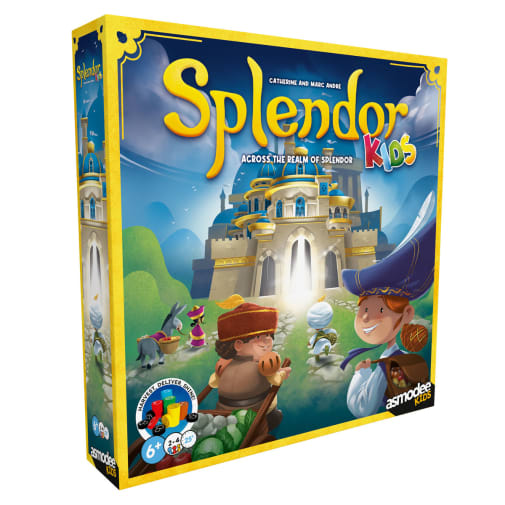
Space Cowboys has done a great job with its 2025 debut of Splendor Kids! Providing an earlier entry into the Splendor series (Splendor, Splendor Duel, and its expansions), it helps younger players get ready for the more advanced versions and introduces them to mechanics that are found in many other board games.
Playing as travelers, players’ goal is to reach the Palace of Splendor at the top of the kingdom board before the gates are closed. There are several paths to move up to get there, and you must have the food required to feed the people in the villages and cities you stop at along the way. Each player has their own player board, which is used to store player resources, including food tokens.
How do players find and collect these tokens? There are resource tokens kept next to the main board in a supply display that represents four different foods. There are also gold tokens, which are wild and can be used for any food. The foods are apples, cabbage, hazelnuts, and water. On a player’s turn, they may do one of the following:
- Obtain three different food resource tokens, two of the same kind, or one gold token. Place these token(s) on your player board.
- The palace board shows which food is required to pass through any specific path on the way to a village or city. If a player can meet the qualifications of the area they wish to pass through, they may move their pawn to that village or city, turning in the tokens they used to move their pawn there. Gold tokens can substitute for any one food. Active City tokens may also be used. These are described below.
Other important information:
- If a player moves to a village, they can take one additional turn.
- If a player moves to a city, they collect a City tile. There is a stack of square tiles near the food resource supply that has one of the four food types printed on it. When a player takes one, they place it right side up at the top of their player board, above their food token area. During the game, a player may use any one of their City tiles as a food source. Once used, these tiles stay at the top of the player board but are flipped over and become inactive until the player obtains another City tile, which activates all inactive City tiles.
The game end triggers when any player reaches the Palace of Splendor at the top of the board. Everyone else takes their final turn, and if other players reach the Palace, they share the victory. The gates of the Palace close, signaling the end of the game.
With a 25-minute game time, Splendor Kids gives kids an opportunity to have the immersive experience of trying different pathways, managing set collection, and obtaining enough village tiles to use some permanent resources, which are the “spine” of the original Splendor game. There are rules and resources for a play variant to add challenge to the game, and before long, your young gamer will be ready to step up to the original Splendor game and Splendor Duel. - - Marsha